


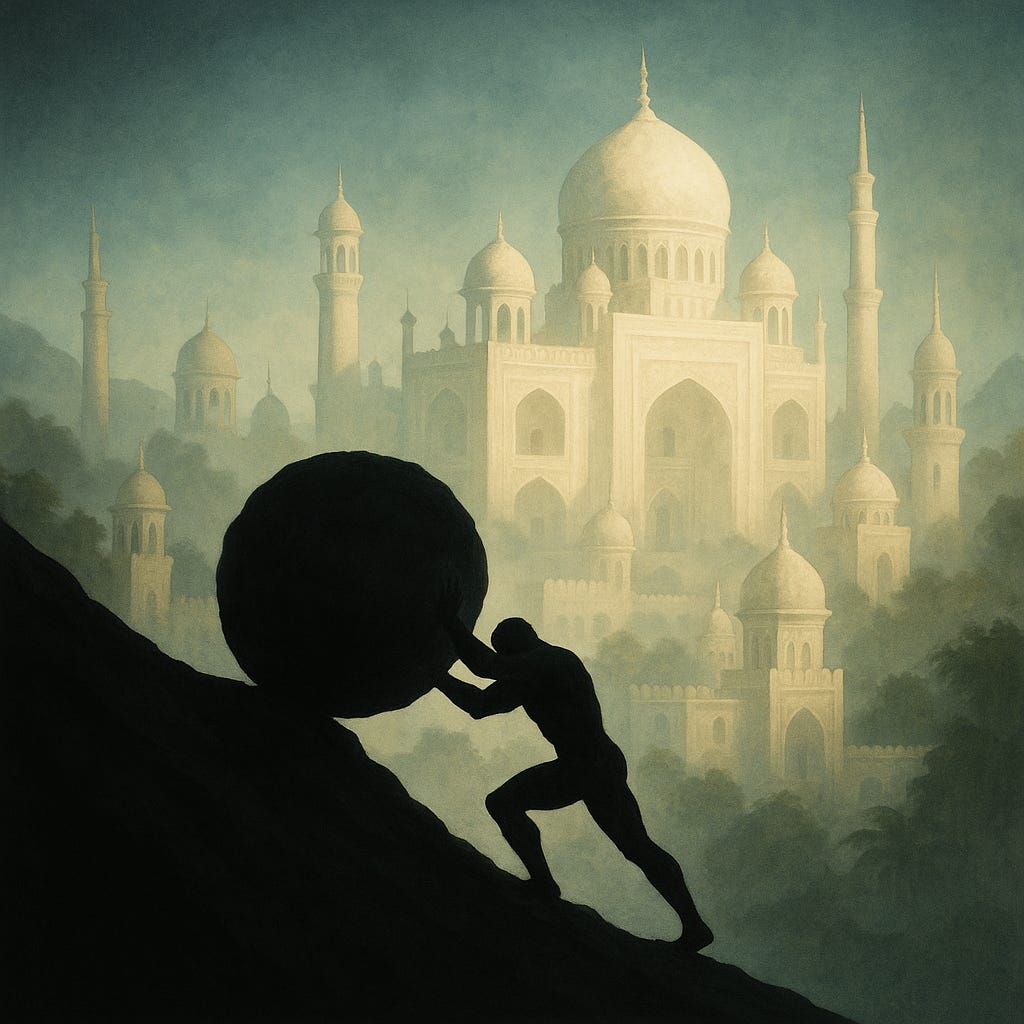
The future is a reservoir of multiplicity that lies within the All’s omniperspective. It’s a space in which what can happen still matters. It holds innumerable paths, but as the present advances, the paths become numbered, narrowed, and winnowed. What was once an infinite constellation of possibilities becomes a dwindling set of alternatives until just one remains.
The now is born.
To act, then, is to reach into the realm of indeterminacy and narrow the range of what will be actualized. Human agency, therefore, is the exertion of becoming extended into the future, realized in the present, and remembered in the past. Even within cosmic constraints—the All is the Law, after all—our choices shape the narrowing.
Remember this cosmic illumination:
The All is Mind; the Universe is Mental.
But a tension emerges. Among the Kabbalists, the world is said to have been shattered into multiplicity, and human beings are tasked with tikkun, which is the repair or raising of the divine sparks. Yet under Kabbalist metaphysics, a vital paradox holds.
The infinite unity (Ain Soph) is forever out of reach, like an asymptote the cosmos approaches but never touches. Yet Ain Soph is everywhere. It flows in our every fiber. If its radiance courses through us, we must remember how to feel it, to channel it, and to undertake this cosmic reordering of which any one of us is only a minuscule part.
Under this construal, tikkun begins to resemble a Sisyphean task: pushing a stone that always rolls down again, or repairing a cosmos that will never return to a perfect wholeness. Camus’s Sisyphus accepts the futility of his labor and somehow finds joy.
Is the Kabbalist condemned to the same fate?
If perfect undifferentiated unity cannot be restored, is tikkun in vain?
The Nature of Tikkun
The Kabbalists do not teach that tikkun aims to restore the original unity. They do not believe that the task of repair is to undo the shattering, or to collapse multiplicity back into undifferentiated oneness.
Instead, the shattering is not a mistake at all, multiplicity is not a deviation, and tikkun is not the reversal of differentiation. Instead,
Tikkun is the harmonization of difference.
The goal is not unity without multiplicity, but unity within multiplicity, something akin to what we have called Organic Unity.
The offspring of being and time—a multiplicity of moments—is not repaired by being fused back into a single unbroken vessel. Repair allows each shard—each differentiated relation—to reflect the divine through its own form of exertion.
To become.
Thus, tikkun is not a return but a revelation. Once tikkun is understood in this way, the bridge to Sisyphian joy becomes clearer, as the infinite unity and the void engage in an ongoing cosmic dialectic under the Blood Moon:
Conception. Negation. Sublation.
Camus insists that in an indifferent universe, the meaning of life is found in revolt—the ongoing act of creating significance through awareness, commitment, and effort. Sisyphus, in embracing his labor, transforms futility into freedom. Vanity into vitality.
The Kabbalist likewise does not repair the world to complete it. He repairs the world to participate in its becoming. His labor is infinite because creation is infinite, not because creation is broken. Life calls us to incessant work, with no final victory. Yet undertaken joyfully, our participation confers meaning.
Camus calls it revolt. Kabbalah calls it repair. Existence calls forth exertion to become.
But to become what?
The Unifying Principle
Across many traditions, a set of insights emerges: If existence is exertion, then meaning arises in our undertakings. Yet we may never get to see what lies beyond our mundane efforts, which threatens to leave us as unwitting slaves to a cosmic process we’ll never understand. If there is an ultimate telos, its contours are invisible. So we will surely err in the undertaking.
Will we succumb to skepticism?
We can at least imagine.
Being exerts itself as presence.
Time exerts itself as change.
Possibility exerts itself as becoming.
Humans exert themselves through action.
Tikkun exerts itself through the harmonization of difference.
None of these aims at finality, merely improvement. The cosmos is not a project, but a process.
We are born with creativity within constraints. Without creativity, we would be automata—cosmic slaves. Without constraint, we would be disordered subjects floating in a disordered universe.
We operate in the grey area.
The future is shaped by our agency even as the All flows through us and sets limits. It might help for some of us to imagine a transcendent God stepping into our temporal condition to evaluate our progress or meddle in our affairs, as a man with a stick might come upon termites building a mound. But the transcendent sky father is but an anthropomorphic projection of ourselves upon a supremely immanent being who knows where all paths lead because the All walks them all.
Still, most of us wonder where we are going.
Progress is Possible
Becoming, as we said, is the process unfolding through the ongoing union of being and time. Some, like Whitehead, think that such a process itself is metaphysically primitive, especially as compared to things or static categories. Possibility becomes a living frontier where being and time meet and mate. The virtual is a mysterious field of sacred sorting where many possibilities become one actuality, moment by moment.
And each moment is a gift we come to appreciate as our hair turns white.
The task of tikkun is not to restore the impossible unity of the Ain Soph. It is instead to participate in the unfolding of the All within multiplicity, harmonizing differences where possible, taking a moment to gape at all the complexity we can take for granted.
We live in a universe, biosphere, and human culture that are not only emergent but radically creative. We live in a world whose unfolding we cannot predict.
—Stuart Kauffman
Reality is the narrowing of potentials through the stricture of the now, a cosmic hourglass through which the All differentiates itself one grain at a time. Universal unfolding is thus a continuous gesture of being exerting itself through time to bring new forms of complexity into existence.
Relations connect more intimately to physical states because they constitute the extrinsic, structural character that physical description captures—how things stand with respect to each other in space, time, and causal interaction, independent of any observer or interpretation. The physical, then, is the relational pattern itself: mass is gravitational relating, charge is electromagnetic relating, and position is spatial relating. These relations obtain whether or not anyone apprehends them.
The mental emerges when relational structures become sufficiently complex and self-referential that information becomes for something—when the network of relations loops back on itself, creating a perspective or standpoint within the structure rather than merely instantiating patterns viewable from outside.
Thus, ‘all is physical’ and ‘all is mental’ aren’t contradictory but complementary. They describe the same relational reality from different vantage points—the third-personal structural description and the first-personal reflexive perspective that arises when the structure achieves sufficient recursive complexity. Both emerge from a generative ground that is neither purely physical nor purely mental but purely relational, with mentality appearing when relations become self-referential, i.e., informational.
Bonding and Bouncing to a Point
In the flux of our experiences, differences appear to collide or coalesce (bounce or bond). Still, the combinatorial effect of all this bouncing and bonding is the cosmos reordering itself—iteratively, ceaselessly.
Teilhard de Chardin’s great insight was that this narrowing is not random drift but, instead, successive moments betray a directionality to evolution. Over greater timescales, the cosmos moves from energy and matter toward life, from life toward consciousness, from consciousness toward a planetary mind. (We are here.) The question is: can we go from that burgeoning noosphere toward something unimaginably more complex yet connected?
Teilhard de Chardin calls this the Omega Point.
The combination of emergence and evolution is the story of the universe learning to know itself, gathering its scattered sparks into higher orders of integration. In Teilhard’s cosmos, as in Kabbalah, the Omega Point is not a return to primordial unity but the emergence of unity-in-multiplicity—a convergence of interiorities that preserves differentiation even as it harmonizes them. Union that differentiates; complexity that personalizes; convergence that deepens our freedom.
To repeat, the task of tikkun is not to collapse multiplicity back into undifferentiated oneness but to illuminate multiplicity, raising sparks precisely by participating in the world’s ongoing differentiation. Repair is not restoration. It’s re-creation.
But not every act of tikkun is random. When you are doing it right, you can feel it. And the shattered vessels of Creation are not unshattered by erasing difference but by revealing divinity through it—as each shard reflects a facet of the infinite.
Like a prism in a beam of light.
Even if you are unpersuaded by the divinity of the All, or that the All is the Law, remember that Camus arrives at an analogous conclusion: meaning does not depend on a final telos. It can be the byproduct of our conscious, continuous exertion. That is why three of the holiest words one can utter are ‘Back to work.’
Sisyphus is not redeemed by reaching the summit. The effort redeems him. The revolt Camus describes is the existential mode of tikkun: the human being taking up the work of making differences cohere, one seemingly pointless exertion at a time, without expecting to see ultimate coherence.
Of course, for Camus, there is no Omega Point. Yet somehow Camus can find both joy and a measure of freedom despite repeating a meaningless task. By contrast, Chardin imagines levels of complexity and coherence breaking through to new levels until the cosmos reaches some, rather neoplatonist, connectome.
He writes,
Under the influence of a personal Center of universal convergence … the multiple is brought together into a harmonious whole … without confusion and without loss of individuality … This is the supreme synthesis, the only one capable of fully satisfying both reason and mysticism.
There is mythic truth in both Camus and de Chardin, but—in the grey—we can imagine life beyond the social singularity and get back to work.
Imaginal Cities
In a precursor to the Codex, I played the role of a minor prophet:
[I]n the social singularity we will coalesce, reconstituting ourselves like some advanced coral reef teeming in an ocean of space dust. We will expand outward into the cosmos until we discover the whole universe was within each of us all along, and we were never alone.
Following Stuart Kaufmann, we can agree that “We live in a world whose unfolding we cannot predict.” Cities beyond the social singularity are our way of describing future evolving concrescences, each perhaps relatively more genial than the one before, but none so perfect as Heaven on earth.
Imaginal cities symbolize a more perfect union in multiplicity, which means still imperfect, but continually improving. Cities of striving. Cities of becoming. Cities of novelty built on timeless wisdom. Symbolically, we can imagine the accretion of something more beautiful, more diverse, and more connected within the constraints of Organic Unity.
We can even imagine someone building a structure brick by brick or a community, neighbor by neighbor.
In an Imaginal City, the whole metropolis might be more splendid due to a modest contribution that forms a greater whole long after death. Yet we will joyfully serve posterity by leaving our children with something better, so long as they take the flame and do the same for their children.
We can know we will have contributed to something more magnificent than any of us could have undertaken alone.
The Process is the Primitive
Being exerts. Time unfolds. Possibilities narrow. The present becomes, becomes, becomes. Every second is sacred. Human agents participate in the cosmic unfolding by sorting some of the possibilities that pass through the hourglass. Every choice nudges the universe’s trajectory. Every act of understanding, compassion, creation, or repair is a momentary alignment with the evolutionary ascent toward greater complexity, interiority, connection, and coherence.
To act then is to collaborate with the deep currents of cosmogenesis, noogenesis, and the patient convergence of Imaginal Cities. To undertake tikkun is to join in the harmonization of differences. To accept the Sisyphean nature of existence is to perform our role in the unfolding with awareness and joy. To exert ourselves consciously is to participate in evolution’s ascending arc.
The meaning of our existence is found not in completion but in contribution. The universe is never a perfect unity awaiting restoration. It is more like an unfinished symphony waiting for our successive movements. As such, we serve as vectors through which the All articulates itself on ever-shifting horizons.
In existence, we belong to the cosmos.
In action, we collaborate in its becoming.
In exertion, we help to realize something greater than we can ever understand.