


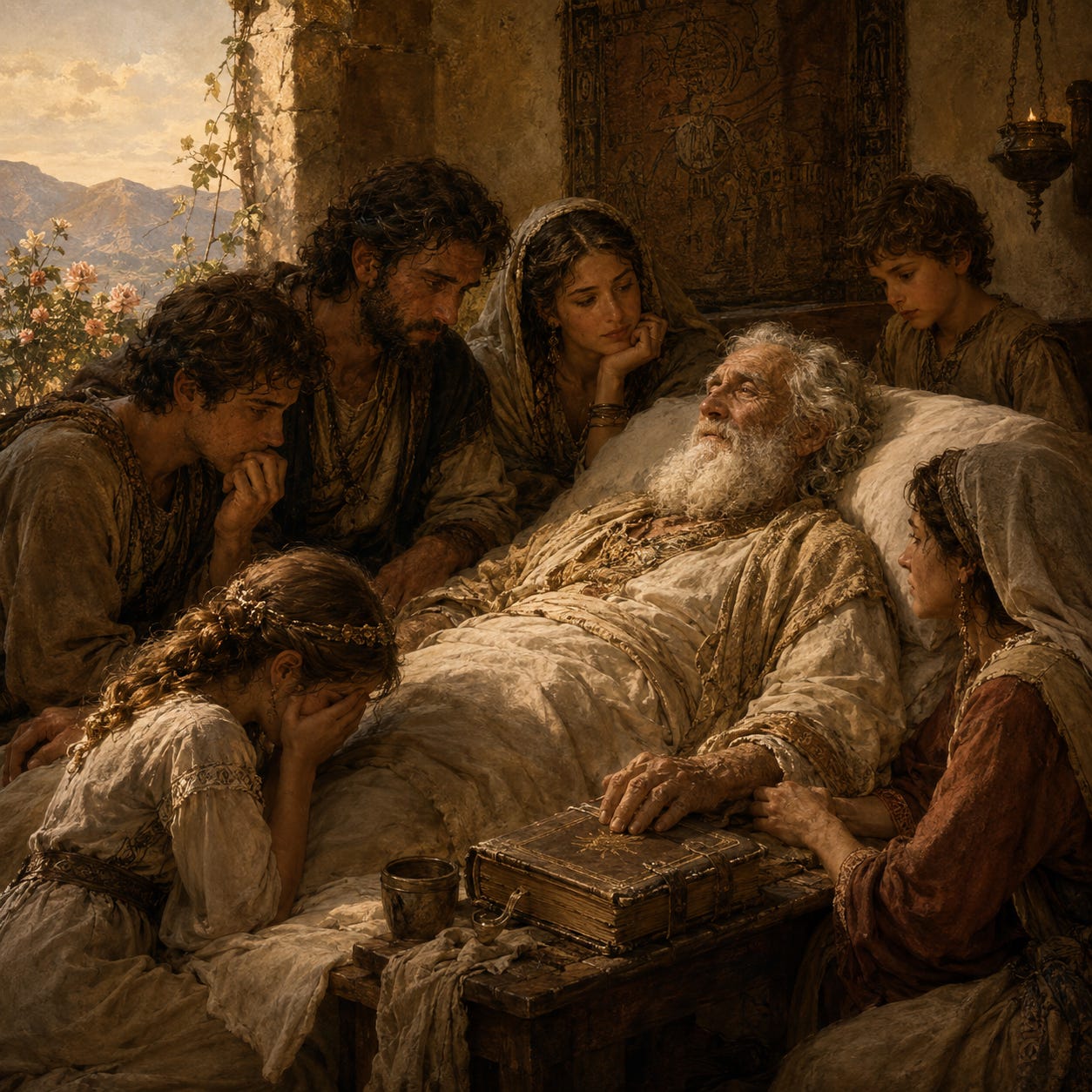
Their father lay dying. It might be days, or only moments, so they gathered about his bed to say goodbye. A sudden vitality seemed to settle upon him—a grace mustered, perhaps, for them.
“Do you have any thoughts you want to leave with us, Papa?” his daughter asked.
He looked at her and smiled, taking a long breath to choose his words.
“Be grateful for the small things,” he said, gazing at the woman who was once his little girl. “When your child grows too old to leap into your arms, you will not think of how your back aches less. You will only wish you had held her a little longer.”
He paused to sip from a cup of water.
“Be grateful for the holy moments. Delight at the young cats scattering papers across your study. See how the hummingbird lingers among the blossoms. Walk out into the day and feel the wind against your skin. Our lives are awash in holy moments we abandon for our preoccupations.”
“Do you have any final wishes?” asked his middle son.
The old man reached toward the bedside table, his hand resting on a bound volume. “Share this with the world, as you are able,” he said. “It holds the seeds for starting anew when a civilization falls.”
“Do you have any regrets?” asked his grandson, who should have been too young for such a heavy question.
“I have tried not to harbor regret,” said the old magister. “Yet I wish I had labored a little less, spent a little more time in your company, and told you what you mean to me.”
He stroked his silver beard, his brow furrowing as if attempting to measure his life.
“You gave most of your years to recording enduring truths,” his eldest son said, low and steady. “Does any single truth rise above the rest?”
“The one that surfaces today might not have done so yesterday,” he replied, “but let me borrow the words of a poet: Into the darkness I go, after the wise and the lovely.”
“But you are wise, Grandfather! You are lovely!” His granddaughter buried her face in her hands, but the tears ran through her fingers.
“Thank you, sweet one,” he whispered. “It seems I am still vulnerable to flattery.”
They wept softly, though a gentle laughter rippled through their grief.
“Truths appear a little less rigid from yonder shore,” the father said. “Yet I will tell you this… the most potent word in our tongue is might. It is the sign of possibility. It puts us on tiptoes, waiting to greet whatever comes next. And who can say? I might simply go to feed the roses, in which case nothing survives this body.”
“There is no harm in nothing,” his eldest son said.
“Or perhaps this flesh was only a garment for an inner witness—a vessel for that which was always an extension of something vast and unbounded. I think I would like to rejoin the infinite expanse.”
“There is no harm in everything,” said his middle son.
“So I am not afraid,” the Magister said. “Find me in the morning sun or the gentle rain. I will be the quiet voice in your mind, or the wind that rustles through the grain.”
“I don’t want to let you go,” the granddaughter sobbed.
“It is the price we pay for having known and loved one another,” he said, his voice fading like the evening light. “But remember this: Love outlives death.”
It absolutely does!