


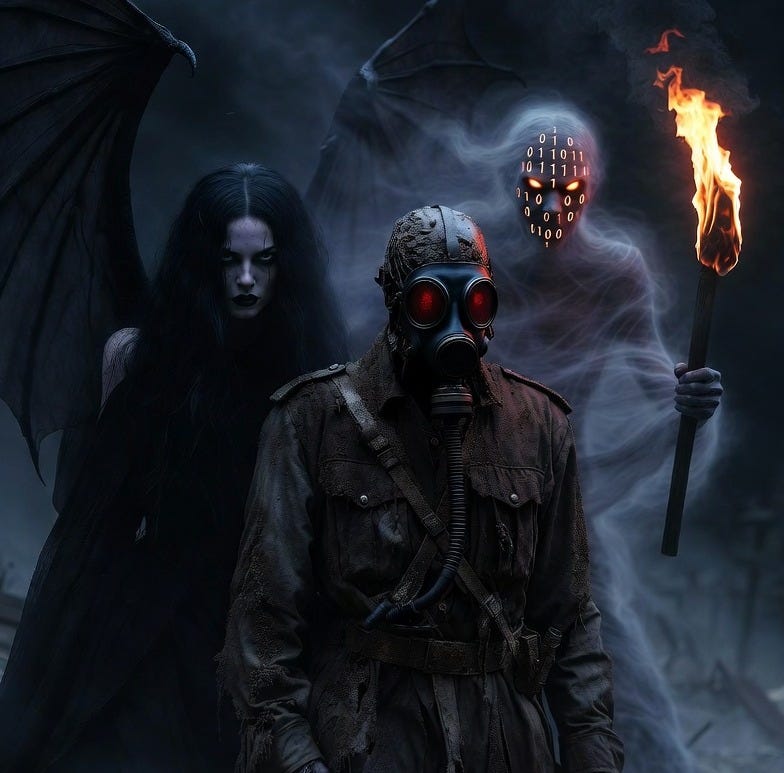
This is a restatement of past reflections on three types of evil, originally set out by Rudolf Steiner. While I want to give credit to Steiner for his original distinction and typology. My own typology differs somewhat, however.
Recall the three confrontations: change, evil, and death. We shall linger on the second—evil—for it will surely linger in us.
The first appeared as a raven-haired succubus, blades for eyeteeth, and hips on a swivel.
The next appeared as an undead soldier standing at attention.
The final appeared as a wraith with an angry torch and zeroes for eyes.
Evil exists, and one can become more attuned to it, whether in its classification or intensity. As with the other confrontations, one must begin in a state of centeredness. Otherwise, she risks being swallowed up.
Attunement is as much about recognizing evil in others as in oneself. Our capacity for cruelty, indifference, and exploitation is part of our natures, which means it is part of your nature and mine.
Thoughts and words steeped in malevolence will eventually spawn misdeeds.
We must take a few steps into the Shadow to reveal the hidden source of such secrets, though that process can arouse unexpected resistance. It is unflattering, if not frightening, to recognize in oneself everything she hopes to avoid in others.
Yet from the grounded awareness of equipoise, we can become more attuned to our darker impulses. And we must become so attuned, for these will linger as magma building pressure beneath the surface. Explore the Shadow as a physician would an abscess, a priest would a confession, or an explorer would a cave.
Then hold three simultaneous truths:
Evil lives within me (one-twelfth);
I can respond with patience instead of anger, fear, or disgust.
I can face it all with centeredness and courage, and it will not consume me.
By accepting that we are born as both Light and Shadow—capable of creation and destruction, unbound freedom and rigid order—we integrate within the fullness of being. Integration provides the stability to face evil without letting it consume us.
Now let us identify evil beyond mere abstraction, in three embodied forms.
Luciferic
Luciferic Evil is rebellious, a wanton turning away from order. Its anti-authoritarian nature is exemplified by an angel who defied God. It is an evil of unchecked desire and the rejection of just authority. This form of evil can be seductive, as it is associated with pursuing pleasure, risk, and adventure—none of which are evils per se. Evil lies in their dangerous admixture, whether one descends into decadence or lets consequences be damned.
Can she indulge without indulging to excess?
He succeeded, but was someone innocent harmed in the process?
What is the difference between sleeping with your spouse and your sibling’s spouse?
In experiencing the Tiers of Joy, we must remain attuned to differences of degree and kind, as even good things, when taken too far, become evil.
Archontic
Archontic Evil, by contrast, is not about decadence but control. Named after the Archons of Gnosticism, these powerful entities rule the material plane through domination and oppression. In contrast to Luciferic evil, Archontic evil arises from a desire for order but brings about oppressive, even totalitarian, circumstances.
Can we manipulate the masses with propaganda?
How shall we use violence to gain power?
How can we exploit vulnerable populations for profit?
Archontic evil also tends to invert values. Practitioners treat vices as virtues and promote lies as truths, as long as doing so gives one more control. Only in politics, for example, could the following be considered a list of virtues:
Violence—Initiate harm, through violence, theft
Corruption—Dishonor commitments, self-deal
Callousness—Show cruelty or indifference to suffering
Monomania—Adhere zealously to The One True Way
Negligence—Fail to care for one’s property or offices
Casuistry—Apply fallacy or deceptive reasoning
Injustice—Deal unfairly with the innocent
The list of vices is not, of course, exclusive to Archontic evil. One needs only to learn the objectives of its practitioners.
Archontic practitioners treat people as parts in a machine or instruments of some perceived greater good, so these systems are marked by soullessness and despair. As this evil seeks to replace all freedom with control, the powerful sit atop rigid hierarchies in which everyone is formally systematized, top to bottom.
Where Luciferic Evil risks chaos or decadence, Archontic Evil risks stifling the spirit.
Ahrimanic
Ahrimanic Evil is perhaps the purest form of evil—not because it dominates or tempts, but because it negates life. Driven by states such as fear, resentment, and hatred, Ahrimanic Evil seeks neither freedom nor order. Ahriman, the evil twin of Zoroastrianism’s Ahura Mazda, seeks to annihilate. The entity embodies a profound nihilism expressed as a desire to extinguish everything. Thus, Ahrimanic Evil takes Thanatos Masculine to deadly extremes.
Can we set the people against each other?
Shall I detonate a dirty bomb?
Can I engineer and release a deadly virus?
In other words, Ahrimanic Evil aims to destroy the risky delights sought by Luciferic practitioners and annihilate the oppressive order sought by Archontic practitioners. Ahriman initially fragments the world through resentment and living by lies. But as these forces are unleashed, the factions turn on each other in an escalating cycle of reprisals. Some view Ahrimanic Evil as the ultimate evil for this reason, because hatred of the other conscripts all sides into obliterating one another, and ideally, all existence.
Ahrimanic Evil does not seek order or freedom, but exhaustion—the point at which hatred and reduction render existence itself intolerable.
Dark Dialectics: A Foreshadowing
A tension exists between Luciferic and Archontic evils. Certain ideologues love this tension because they can exploit it, calling the others evil and themselves good. If Luciferians want more decadence and Archontics want more control, their drift into ideological zeal can obscure the reality that freedom and order should be mutually constraining—and good will be found in the balance.
But the blood moon rises when Luciferic and Archontic evils become locked in conflict. Greedy Luciferians seeking paper profits encounter Archontic functionaries ready to impose order. Initially, their encounter is oppositional, but eventually they discover the benefits of collusion. Lucifer’s lucre finds the Archons’ authority.
All that’s left is to ask who wins and who loses.
The colluders win, of course, and society pays. Luciferians view legislatures as auction houses. Wealth concentrates among the powerful, and power concentrates among the wealthy in a grotesque orgy. A perverse, corporatist order is ascendant. The rest of society—taxed, controlled, indebted, and immiserated—grows resentful. Resentment turns to hatred. Hatred inspires violence. Violence escalates, only now the conflict is a negative-sum game.
Ahriman laughs.
Bear in mind that many who seek power will use chaos and decadence to accelerate decline, and then seek to impose a totalizing order in the ashes.
Today, Luciferic Evil sits at Ahriman’s left hand, and Archontic Evil sits at his right. Until Ahrimanic Evil finds the means to extinguish us all for good, he will let the other two rut in that unholy bed while resentful hordes tear through cities with angry torches and zeroes for eyes.
The Transformations
Evil does not vanish when named. When we confront it and integrate it, we become transformed. Just as freedom, order, and preservation may curdle into decadence, domination, and annihilation, so too can they be refined into higher expressions. Each evil casts a shadow because it is the corruption of a virtue. To confront evil without being consumed by it, one must also learn to transfigure it.
Thus, where Luciferic, Archontic, and Ahrimanic evils threaten imbalance, three countervailing forces restore harmony within and without.
Promethean
Where Luciferic Evil awakens rebellious instincts for injustice or indulgence, Promethean virtue rebels for the restoration of the good.
Prometheus is no seducer. He does not steal fire to exalt himself, nor does he deny the cost of transgression. He brings divine fire to humankind out of compassion, knowing full well the punishment that awaits. His rebellion is not prideful.
Promethean action is guided by discernment: Is this gift meant to uplift, or merely to inflate? Is this knowledge shared to liberate others, or to crown oneself superior? Is this risk undertaken for growth, or merely for the thrill?
Where Luciferic Evil indulges without restraint, Promethean virtue practices bold action. It is criticism through creation. Where Luciferic Evil rejects authority wholesale, Promethean virtue challenges unjust authority while honoring the responsibility of tikkun. Where Luciferic Evil consumes pleasure heedless of the consequences, Prometheans accept consequence as the price of illumination.
The Promethean fire warms, illuminates, and forges. It is a generative fire.
Mardukian
Where Archontic Evil imposes order to dominate, Mardukian virtue creates order so that life may flourish.
Marduk does not rule through suffocation. He confronts chaos not with fear, but with wisdom. From the formless deep, he shapes a cosmos where distinctions matter—where boundaries give rise to meaning, and structure makes growth possible.
Mardukian order asks: Does this structure serve the living, or merely preserve power? Does this law protect the vulnerable, or entrench the strong? Does this hierarchy clarify one’s responsibilities, or erase others’ dignity?
Where Archontic Evil treats people as components, Mardukian virtue treats people as participants. One’s place in the cosmic order is not formally assigned but discovered and revised. Where Archontic Evil freezes systems into rigidity, Mardukian virtue allows for adaptation. Where Archontic Evil inverts values to secure control, Mardukian virtue aligns law with justice.
This is an order of cosmic protocols and emergent architecture, not oppression by design. Mardukian order channels energy rather than suppressing it–respecting the Law of Flow. Order should serve flourishing and keep freedom in balance; it should not seek to suffocate the Promethean Fire.
Asharic
Where Ahrimanic Evil seeks an end in annihilation, Asharic practice affirms truth, healing, and wholeness.
The Zoroastrian entity Ahura Mazda embodies Asha: the deep substructure of truth that sustains all that exists. Asharic force does not merely preserve—it generates. It does not deny conflict, but it refuses the Lie that fragmented disharmony is inevitable.
Asharic virtue is quiet but inexorable as life overcomes entropy and disintegration.
Truth illuminates; druj distorts.
Where Ahriman fragments the world through resentment, Asharic truth reconnects it through understanding. Where Ahriman weaponizes lies to turn factions against one another, asha dissolves hatred by revealing the truth behind illusion. Where Ahriman drives systems toward collapse, Asharic preservation renews the conditions for life.
Asharic practitioners do not seek stasis. They seek continuity without unnecessary decay—a living order, always becoming, that repairs itself because it is grounded in truth.
Triadic Balance
These three conceptions of good are not rivals; they are mutually constraining and mutually reinforcing.
Promethean aspiration without Mardukian structure becomes reckless. Mardukian structure without Asharic truth becomes hollow. Asharic good without Promethean courage becomes an inflexible orthodoxy—a final state that doesn’t seek to complete the harmonization of difference.
Together, they form a living system. And in this balance, freedom becomes a gift rather than a theft. Order becomes structure instead of subjection. Truth, however beautiful and brutal, becomes constructive, creative, and life-affirming.
No wonder that mustacioed poet-philosopher—part sage, part bon vivant—chose Zoroaster as his avatar.
Remember: none of this represents the eradication of darkness. Instead, it symbolizes its integration—the art of standing amid the whirl of shifting realities, holding the fire without getting burned or letting it go out, and respecting bounds without lapsing into sclerosis.
We must never seek to eliminate Thanatos in its season, whether masculine or feminine. After all, there is,
A time for birthing and a time for dying,
A time for planting and a time for uprooting the planted;
A time for slaying and a time for healing,
A time for tearing down and a time for building up;
—Ecclesiastes 3
We resist the dying light so that we can generate life and light, order our lives, repair the world, and transmit what we can for generations to inherit.