


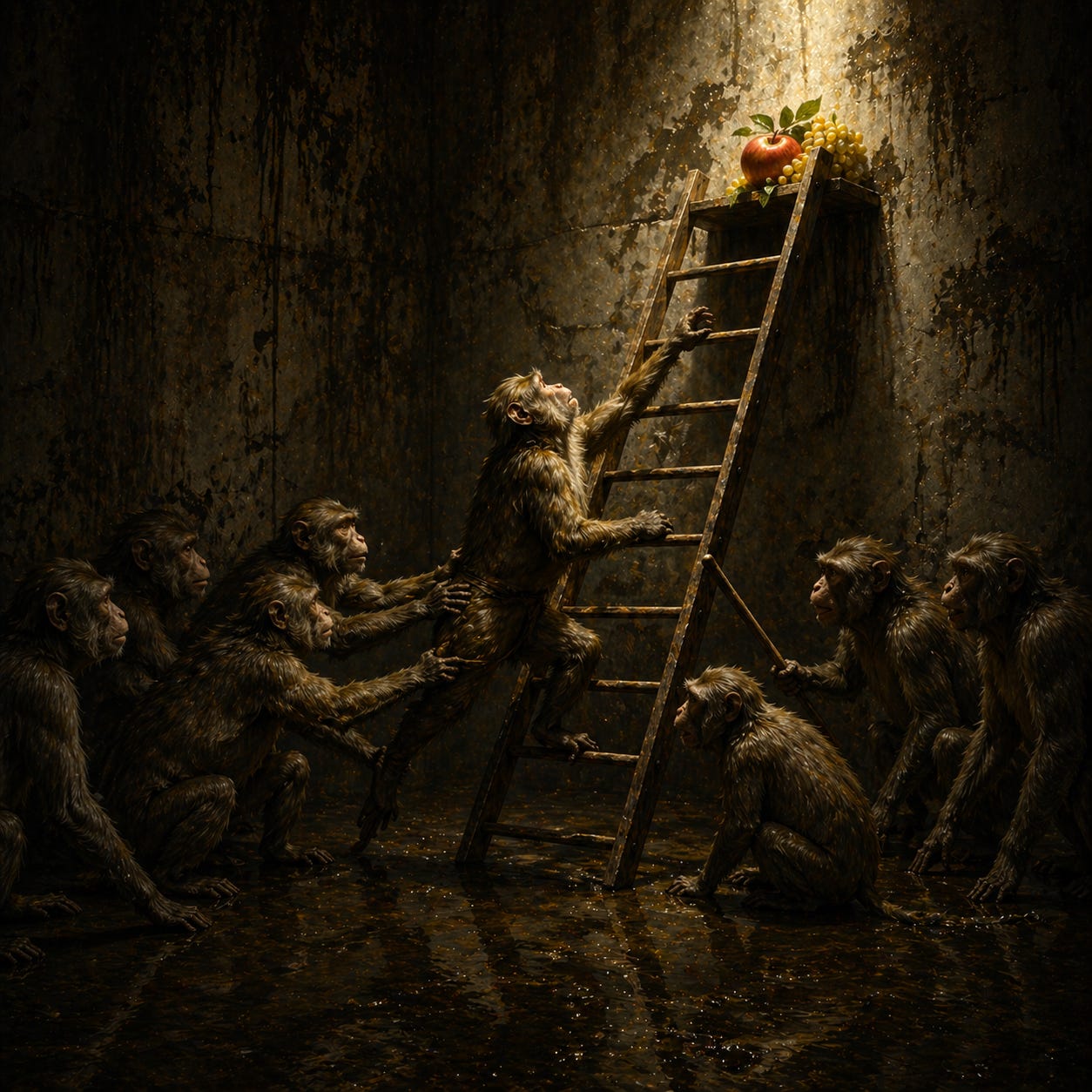
Once long ago, keepers kept monkeys in a room with no ceiling. In the room, a ladder stood, and at the top of the ladder, there was fruit. When a monkey climbed for the fruit, the keepers drenched all the monkeys with cold water—the reaching monkey and the resting monkeys. Eventually, the monkeys learned to pull down any that climbed the ladder, and to beat them, so that the cold water might not fall from above.
Then the keepers took away one of the original monkeys and brought in a new one who knew nothing of water. When the new one moved toward the ladder, the others set upon him and beat him down. In time, the keepers replaced every monkey in the room. Yet none that remained had ever felt the cold. Yet the ladder stood untouched, the fruit went unclaimed, and any monkey who reached for it was beaten by those who could not have understood why.
Those who strike down one who reaches should ask themselves if they remember why.
Two Ways of Making Order
Siblings who come to climb the spiral staircase will come to understand two ways of seeing order, which imply two ways of generating order. As societies become more complex over time, their people must adapt their cognition and values to keep pace with accelerating change. It makes sense that as we move through time—from primitive nomads to city dwellers—our ways of seeing and being must change along with our environments.
The work of metapolitics is to ask, of each thing presented as the only way, whether it is even the kind of thing it claims to be. The siblings will discover that this single question, asked at deepening levels, opens what follows.
A finite game is played for the purpose of winning, an infinite game for the purpose of continuing the play. —James Carse
The magister drew a distinction worth keeping close to the breast. Some games are played to be won, others to be continued. The finite game has fixed rules, known players, and an ending. Its purpose is to win until another finite game begins. The infinite game has no such ending—its rules may change, its players may come and go, and the only purpose is to keep the game alive such that the players thrive.
Politics, as we have inherited it, is a never-ending series of finite games, that is, contests with winners and losers, fought over the same board, by parties whose quarrels seem to matter more than the question of what kind of games the board unleashes.
Metapolitics begins when that question is finally asked.
But it is fundamentally the work of writing rules for a game meant to continue—and of recognizing that arguing over which faction should win the present contest is a far smaller concern than whether such a contest, as currently configured, is one the people should be playing at all.
Most finite games are played to dominate, which determines a winner and a loser. The deeper question is what kind of game the rules themselves generate.
Thus, there are those who say we ought to live in that numbers game where the majority selects its rulers who make the rules and plan the order such that it determines the winners and losers in a given period of gameplay. Complicated rules for a finite game—a game of domination.
Then there are those who say that the numbers game is an illusion that obscures the win-lose dynamics of central authority, and mutes the aspirations of those who would rather play an ongoing cooperation game—according to rules of fair play and proportionality—simple rules for a complex society.
The Great Ascent
One who has not yet made the great ascent up the spiral staircase might not be able to appreciate the differences. Still, she might parse the perspectives of the idealist and the skeptic—and ask whether the system she has been told she lives within is the system she actually lives within.
Our system stands as a beacon of human dignity, allowing us to have a direct or representative say in the decisions that shape our lives and society. Rooted in the principles of equality, our system empowers individuals to register their choices, with each having an equal say compared to any other, until the greatest aggregation of choices prevails. Representatives become our servant leaders. By encouraging participation, our system enables those leaders to build a thriving society in which the majority’s will is balanced against protections for certain groups. Transparent, accountable institutions are designed to serve the people, reflecting our belief in the inherent value of every human being. Though it may face challenges, our system remains an inspiring form of government, continually adapting to meet the people’s needs.
Such a noble ideal. What does one see who looks past the system’s image of itself?
Your vaunted system suffers due to the tendency of power to concentrate. Where multiple, competing loci of decision-making authority would better reflect the diversity of people in society—in experimentation, competition, and cooperation—central authorities seek to make simple decisions for a complex world. People in faraway places cannot adequately address a community’s needs because they cannot know what those needs are. Favor-seekers gather in those faraway places to bid for the power that the representatives place on an auction block. The people are powerless compared to the favor-seekers, who have a direct stake in the details of deliberation and lawgiving. Thus, small but powerful interest groups gain significantly, while the people bear the costs, which mount over time. Such leads to corruption and, therefore, disillusionment among the throngs who feel unseen and unheard despite the plebiscite.
Both of the foregoing passages describe politics, but only one sees clearly enough to summon metapolitics.
If the rules of an order shape the games played within it, the rules also shape the kind of leaders the order summons. Two more voices surface and compete for our assent.
The first voice says,
I have special insight as to the nature of a good society. Some disagree, but I am a Designer. While it is unfortunate that some don’t share my ideals, those with insight can rise to build and protect the overall good. Those who possess such insight must lead. It’s unavoidable. If we’re to build and protect the overall good, leaders must compel those who lack our insight.
The second voice says,
People have different ideas about what makes for a good society, so we should focus on building strong communities. I wish to live in my ideal community and want others to live in theirs. As long as we agree to protect the innocent, my ideal society is one in which people can choose the community or system they believe offers them the best chance to flourish.
One voice is black and white. The other is a shade of grey. One seeks to manipulate, the other seeks to catalyze. The first is the kind of leader the command-and-control order will summon. The second is a leader that spontaneous order will invite.
Metapolitics is not just the art of knowing the difference; it is also the discipline of understanding how complex societies emerge to serve diverse people within a unified framework. E pluribus unum. Ex uno plures.
Complexity is a god before which all must remain humble.
Conceit of the Designer
She walks the high halls where the powerful gather, and they send for her before they deliberate, but she must wait in line behind the favor-seekers. Her days are given to deep reflection and planning, to gathering knowledge across many disciplines, to seeing patterns that escape lesser minds. She does not think as others do. She perceives what lies beneath the surface of things, and she calls this faculty by a flattering name: the Designer.
She believes she can see the whole system, even before it exists. So she believes she can plan systems for others. The commercial ecosystem becomes a machine she can design and run, or society a tapestry of relationships she alone has learned to weave. Those who lack her sight are bound to walk the unlighted path of ignorance until she leads them out of the dark. She sees no tyrant in the mirror. She sees a servant of the common good whose vision will fix what the blind and benighted have broken.
She must light the path that others must one day walk.
Beware the Designer, not because she is evil, but because she lacks the one thing sight requires—humility before what she beholds.
The central task of those who would order society is to show how little they can know of what they imagine they can design. The myriad decisions about what to truck, barter, and exchange are beyond the ken of anyone who would contrive them, just as the relationships of a rainforest ecosystem could neither be designed nor created by anyone. Living systems will override the plans of those who plant by hand. What organizes itself from below will outlast the schemes of those who plan from above.
The Magister writes of ruins in a rainforest.
The complex includes temples, plazas, and thoroughfares once teeming.... This once-great civilization eventually drifted into obscurity. Some say a mixture of drought and excessive foresting caused the inhabitants to abandon the city. Since its heyday a thousand years ago, the jungle has been unforgiving in its vengeance.
A tidal wave of flora has swallowed the buildings, roads, and temples, turning mighty stone structures into mounds nearly indistinguishable from the surrounding landscape. Mother Nature can be relentless as she uncurls her snakes or unfurls her fronds. So, the city has returned to nature in unparalleled beauty and biodiversity.
No mind, however fine, can design a reef or a rainforest—much less a single cell.
Inside a cell, one finds affairs that never cease—messengers in motion, gates opening and closing, signals sent and answered in a script too fine for any one mind to write. What each cell observer knows, he knows in fragments. Patterns glimpsed, rhythms inferred, meanings sketched in outlines. Each holds a shard of the truth, and only by working together can they approach understanding the whole.
A society is no simpler. Complexity defies understanding and thus planning. The one who believes she can arrange the lives of many as a hand arranges pieces upon a board has forgotten that each piece moves of its own accord on a board that is a human-interaction landscape.
The ascended should never stop trying to understand, but they should stop trying to command. Yet the Designer lingers, claiming:
There are those who say we must learn to live in two capacities: as makers of the orders under which we live, and as those who live within them. As ones who live within, we need not hold the whole in mind; we may go about our small work and trust that the order will tend itself. But as makers, they say, we must hold the whole in mind, for the order will not arise of itself. What seems to move by an unseen hand must in truth be built by a seen one.
Such a conceit will not stand, because that jealous god, complexity, will not let it.
Those who study living things have long passed over the way that order arises of itself, not because such ordering is rare—it is everywhere, and it is deep—but because they have not yet learned to think of systems shaped at once by two makings. If ever a true understanding of the living is to be reached, it will require seeing how what arranges itself—self-organization—and what is winnowed by trial and error—selection—are woven together. We ourselves, those who study and those who are studied, are the expressions of that deeper order.
The best we can do is launch experiments in protocol design—whether through local experiments or emergent rule sets.
There is no One True Way.
Local is Beautiful
We need to make room for niches of experimentation so the twin forces of emergence and evolution can work their magic. We need more local eyes on local problems. And only good protocol design can unleash all the experimentation.
Good protocols can originate in theory or emerge from practice.
Remember, the value of a whole is not always the sum of the value of its parts. How the elements are joined, how they answer to one another, how they stand in relation one to the next, going in flux and flow—these can give a whole a value that no counting of elements would uncover. Just as a tune is not the sum of its notes, a people is not the sum of its persons. Every dynamic arrangement and rearrangement is enormously valuable, and the churning value of the arrangement is greater than what is arranged.
Such wholes are made not by sameness but by the maximization of elemental diversity along one dimension and the harmony of those elements on another. A theory that explains many phenomena with a single principle has this quality. So does a society whose people pursue diverse ends under rulesets that unify them equally. The unifying element does not erase diversity; it shelters it and gives it common ground.
From this follows a second teaching, which the first prepares.
No single vision of the good life can satisfy all who would live well. What seems to one a paradise seems to another a prison. What community one would build, another would flee. Those who insist their vision must be the vision for all have not understood what they are asking of them.
There is a better framework.
The Framework
It is not a single order planned or imposed, but a framework of rules within which many orders may arise. In such a framework, those who would live one way may gather and do so; those who would live another way may gather and live otherwise. None is bound to another’s vision. Each may join the community whose good is good to them, and each may leave when it no longer suits him. The framework itself takes no sides among the visions it shelters, unless a vision becomes imperialist. Its purpose is to protect the many parallel ways of living peacefully—tried but never imposed.
This is no small thing, and it is not what most men mean by order. Most mean something narrower: one true folk, one true way, and one answer to the question: How are we to live? A framework that houses many answers is harder to grasp and easier to forget. A framework that houses many answers is born out of metapolitics.
The framework, when in operation, gives rise to a country that is greater than the sum of its communities. In this land, each community lives mostly by its own lights, tends to its own good, and is free to be joined or abandoned. The variety itself is good, because no two people are the same. That no one vision prevails is good, because together, people can contribute to a flourishing society that no single visionary, however savvy, could have designed alone.
It is the land of a thousand visionaries.
Unclaimed Fruit
Return now to the room, and the ladder, and the unclaimed fruit. One who reads is not necessarily one who climbs. One who has read this manuscript might wish to be a keeper. Who has begun, at least, to see the monkey ladder for what it is? It is enough, for now, to stop striking down those who reach. It is enough, for now, to test the ladder again. In time, perhaps, a few of us will climb, perhaps to seize the fruit, but also to see what lies beyond the room.
Let us then go forth, to live by the Covenant and the Law of Consent, and carve out niches of possibility for a society full of people weary of living as cold, wet, or beaten monkeys.
On my second read. Anticipate a few more.
Spontaneous order without custody becomes unmanaged emergence methinks... and custody without release becomes institutional capture.
More and more I feel the viable (Carsian) civic organism has to do both: metabolize local reality and refuse permanent possession of what it helps grow...