


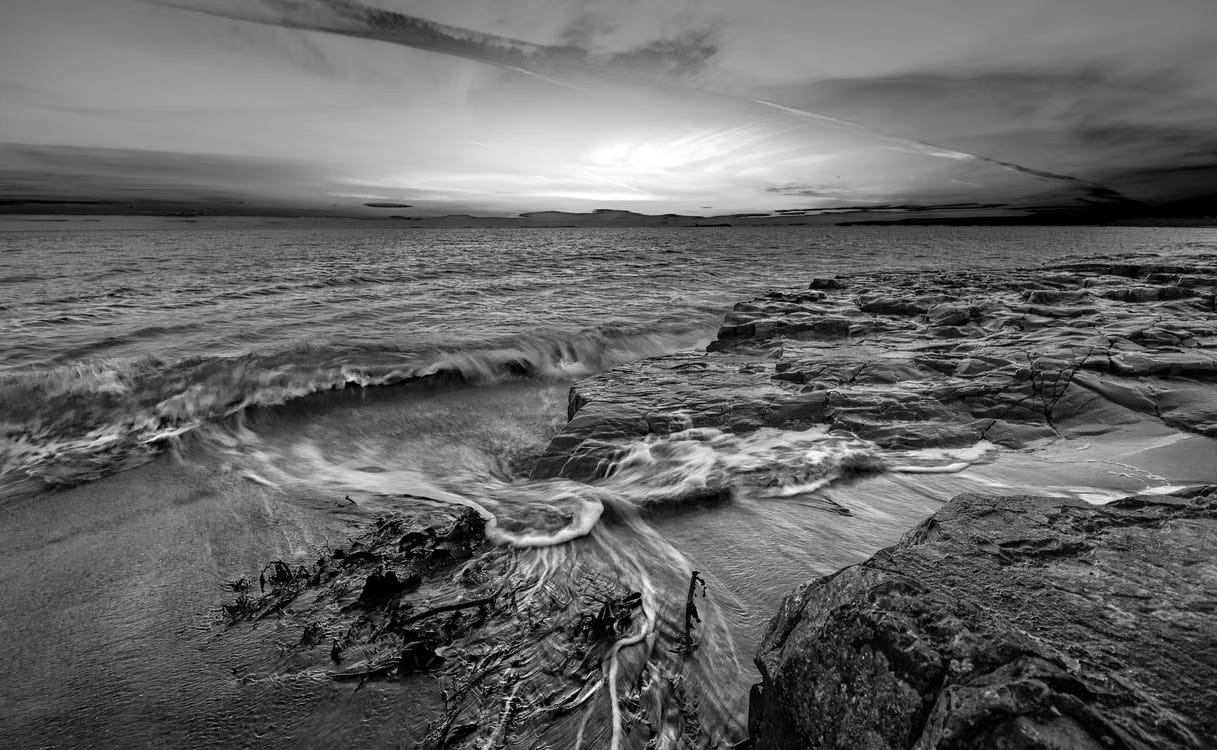
There was once an old man who lived beside a small tidal cove. He despised the ebb tide. Each evening the sea withdrew, exposing tangled weeds, broken shells, fiddler crabs, and driftwood upon the shore.
The old man mourned what he believed the water had taken with it. So he built a stone barrier across the mouth of the cove, determined to keep the sea from retreating.
For a time, the cove remained full. Its surface became smooth as glass, and the old man congratulated himself. But the water no longer breathed with the tide. It grew stagnant and foul. Fish floated lifeless upon it. Only gulls and carrion birds came to visit.
One evening, an old woman stopped beside the cove and said, “The flood tide does not bring the sea, nor does the ebb tide take it away. Each makes way for the other.”
The old man, weary of the stench, knew she spoke the truth. Together they broke the barrier stone by stone. The trapped water rushed out to meet the living surf.
By dawn, the tide had returned, carrying cool water, darting fish, and fresh strands of kelp from the open sea.
Mortido and Libido
Mortido is the subconscious drive toward death and dissolution, representing the internalization of entropy. Libido is the conscious push toward life and emergence, representing our generative natures, but also the concentrated energy that must be summoned to push through to new levels of negentropy. We must take care not to make the distinction between them too value-laden, though. To do so would be to moralize about high tide or low.
The polarities are both experiential and existential.
Because generative accretion has stakes—even meaning—in the possibility of things coming undone, the drive toward dissolution is what gives the push toward unity something to work against and something to work for. Libido is thus not some salutary force that death simply interrupts. It is a natural antagonism mortido provokes—structure raised as a response to the pull that would otherwise dissolve it. Thus, the negative moves first, and then the libidinal urge rises to challenge it.
Indeed, the hierophants teach us that mortido drives libido under the Blood Moon.
Mortido without libido is an opening into the absolute void. Libido without mortido is a totalizing stasis where nothing can open. In terms of events—in the dynamic flux of becoming—novelty is the product of mortido and libido struggling to assert dominance. Ironically, we experience life not as the victory of libido, but as the struggle itself, until one day mortido has the last word—at least in this particular configuration and in this peculiar life context.
Gnosis and Nature
Gnosis, according to the Gnostics, is direct, experiential, and transformational knowledge of the divine. It is a kind of inner awakening that reveals both one’s spiritual essence and the hidden reality behind the material world. Gnosticism teaches that the physical universe was fashioned by an inferior creator, the Demiurge, rather than by the highest God. This distorted creation leaves divine sparks trapped inside humans. Salvation, therefore, comes through gnosis, which is achieved through a process whereby one discovers the divine spark.
One might describe gnosis as a return to one’s divine origin, the path back to the transcendent source beyond the familiar physical cosmos. To the modern sensibility, Gnostics are not only dualists—that is, they understand the world as divided into the causal-physical and the mental-spiritual realms—they also invert what is fundamental and what is illusory. In the main, only those who have consumed sacramental substances or had near-death experiences are willing to defend the experience of gnosis and the very idea of a deeper reality beyond the material realm.
By contrast, most people have the opposite understanding of nature, that is, of the natural world. Even though one never directly experiences the noumenon—nature’s palpable reality—it is intuitive to the modern mind that the point of our percepts and concepts is to come as close as possible. The scientific-objectivist worldview is therefore that we are agglomerations of matter and energy exploring other agglomerations of matter and energy.
While we haven’t quite figured out how to see beyond our conscious states to all those things-in-themselves, they are there. However imperfectly, our conscious states represent them. That is nature. Such is not the imperfect, even befouled, creation of a Demiurge, but a strange reality waiting for us to describe it, explain it, and understand it.
In our Order, the distinction between nature and gnosis is too sharp. The Gnostic says the material world is not ultimate, so we must awaken to a deeper order. The naturalist says the material world is ultimate, so understanding its lawful structure is what matters.
After many lifetimes of inquiry, we must conclude there is a deeper dynamic at play, which one might call gnosis naturalized. Rather than viewing matter as a kind of spirit prison, we understand spirit—qualitative mental states—as emerging from the natural world through the cosmos’s evolutionary unfolding. In this way, fulfillment is found not in escaping the universe but in consciously participating in its ongoing development.
Nature is therefore neither merely an illusion nor merely a mechanism. It is an unfinished process of becoming—a creative unfolding through which the universe gradually becomes conscious. Gnosis is the state of one’s awakening to his role in the cosmos as an agent of its own self-discovery. Gnosis is therefore not an escape from nature but awakening to it more fully. Mortido and libido, quite strangely, become the proud parents of gnosis naturalized.
Perspective Shift
Recall how an event occurs. Mortido opens, libido fills the opening, and novelty issues from their ongoing struggle. Gnosis naturalized parallels this ongoing dialectic, but to what scale we cannot say. The universe’s long dissolution—entropy, that seaward pull as everything comes undone—is not the enemy of the awakening cosmos but the clearing in which that awakening becomes possible. Each dissolution creates a creative void, and each generative surge raises a new structure to fill it.
Consciousness is the improbable, accumulating result of cosmic primitives bonding and bouncing in increasing complexity, until they form themselves into something capable of reflecting on itself and the emergence vectors from which it came. Far from being knowledge smuggled in from beyond nature, Gnosis is what the fundamental drives produce when their iterative struggle runs long enough and builds high enough—the moment the negentropic climb arrives at a structure complex enough to understand itself as something that climbs, reflects, and experiences oneness with the All.
Thus, the drives are the parents of gnosis naturalized, and not merely its precondition. Mortido gives this cosmic awakening its higher stakes, and its opening. A cosmos that could not come undone would have nothing from which to wake from and no reason to wake. Libido pushes until the actual raising-up of form, life, and mind defies entropy. What the Gnostics mistook for a spark exiled in matter is nature’s complex ignition. And what, over cosmic time, bursts forth from the All? Sentience. Consciousness. Spirituality. To awaken is not to escape the struggle of dissolution and generation, but to recognize oneself as its most sacred expression—and to take up, knowingly and happily, the part one has no choice but to play.
Memento mori.
Amor fati.
In ordinary perception, consciousness faces outward and downward: it treats itself as one finished object among objects, a late agglomeration of matter looking at other agglomerations. This is the stance of the naturalist, who takes the world for brute reality—accurate, but it perceives the cosmos as a product, as the settled result, that is, matter already crystallized. It sees the low tide: the world as deposited fact. Call it perceiving the cosmos as a thing.
In the gnostic moment—the sacramental opening—consciousness turns inward and perceives back along its own emergence vector. It stops perceiving itself as a finished object and catches, for an instant, the process still generating it: the negentropic climb still climbing, itself at the living edge of the cosmos’s self-assembly rather than some separate, completed piece of furniture in the museum of the past.
When people describe an experience as more real than this reality, that is what they mean to report. It is not some truer world located beyond, but the self-same world caught in a perspectival shift to the process of becoming. The pose of having-become is more mediated, like evolution’s controlled hallucination. But in the gnostic moment, one sees the tide itself, not what it deposits.
One must not be misled, however, by the uncanny theater of the threshold—the strange architectures, intelligent custodians, or weaving forms so often reported from these depths. The traveler who encounters such phenomena has not wandered into a wholly other domain. Instead, he experiences the mind’s native representation system translating raw operational forces into visual forms.
Humans experience the All’s self-organization as a living, intentional force. When the ordinary filter of perception drops away, the mind sees creation in action. Because this generative process feels so alive, we interpret the dynamics as autonomous. Mythical beings are therefore not visitors from another realm. They are the unveiled events themselves translated into new symbols the human mind can detect and digest.
Thus, the traveler who returns from the sacred threshold and insists the vision was more real than this world is describing no second world. The exiled spark is but an unshifted perspective. What we are capable of glimpsing is nature caught in the act of forming itself, with mortido and libido still engaged in the struggle.
The world as we live it is true, but it is a lesser truth—the residue of events. And we are, each of us, a place where the cosmos managed to turn around and catch a glimpse of its handiwork.
After my nap, I will look in my tool chest and see if I have the right spanner for this.