


The psychology of the mature human being is an unfolding, emergent, oscillating, spiralling process marked by progressive subordination of older, lower-order behaviour systems to newer, higher-order systems as an individual’s existential problems change. Each successive stage, wave, or level of existence is a state through which people pass on their way to other stages of being. — Claire Graves, The Never Ending Quest
A rhizome has no beginning or end; it is always in the middle, between things, interbeing, intermezzo. The tree is filiation, but the rhizome is alliance, connection, and heterogeneity: any point of a rhizome can be connected to anything other, and must be.”
— Gilles Deleuze & Félix Guattari, A Thousand Plateaus
Every order must have its scribes and its shamanoids. This is especially true of our order.
The scribes, or priest-like siblings, are responsible for setting down and protecting the doctrine. Core features of our doctrine are the Unquestionable Answers.
The shamanoids, or shaman-like siblings, are responsible for reaching out to the edges of inquiry. We have referred to such challenges and questions as basking in the mystery—that is, to ask the Unanswerable Questions.
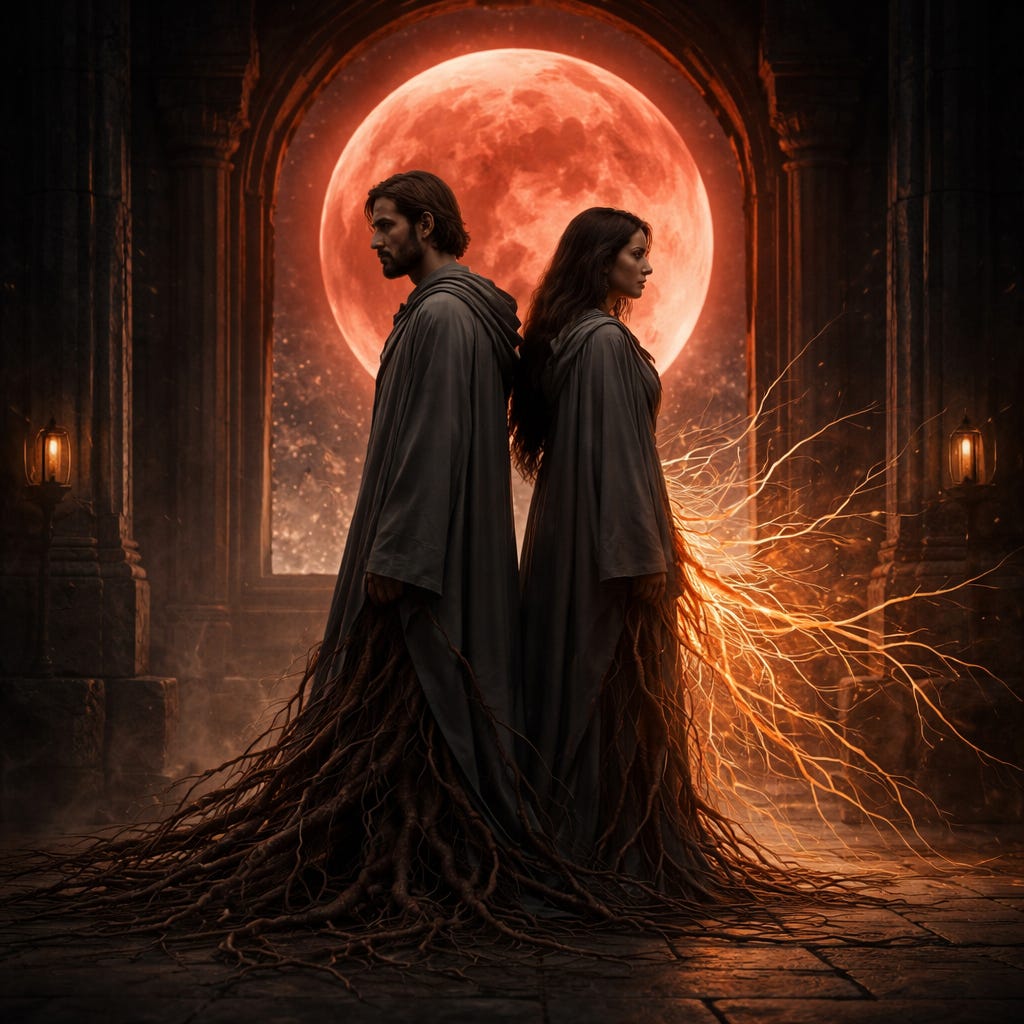
Scribes and shamanoids operate in dynamic tension under the Blood Moon.
Where the scribe protects the transmission of wisdom that endures over time, the shamanoid has visions that occasionally challenge the existing order, allowing it to evolve. Sometimes they argue. But in their argumentation, they represent internal functional dialectics.
We shall call these functional dialectic pairs roots and rhizomes.
Roots
First, recall the Ascending Orders, which are partial orders, or suborders, of our siblinghood taken as a whole. These correspond with stages of psychosocial development.
Tier One: A Sibling’s Psychosocial Journey
Order of the Naked. Survival stage focused on basic needs (food, water, shelter). Ascend by mastering one of the four elements.
Order of the Moon. Magical/familial stage centered on tribal bonds and rituals. Ascend by gathering with others around a fire under the moon until dawn.
Order of the Fist. The power-and-glory stage is driven by strength and competition. Ascend by winning a competition without harming the innocent.
Order of the Pyramid. Structure and order stage valuing hierarchy and discipline. Ascend by trusting superiors to guide you while blindfolded.
Order of the Sun. The achievement stage emphasizes reason, commerce, and scientific progress. Ascend by earning profits or sharing new empirical knowledge.
Order of the Leaf. Communitarian stage prioritizing equality, consensus, and care for all. Ascend by organizing a community feast or giving gifts.
Tier Two: Of Hierophants Ascended
Order of the Nautilus. Integration stage, weaving together complexity and diverse perspectives. Ascend through subversive innovation or communication.
Order of the Lotus. Holistic stage, recognizing cosmic interconnection and unity with the universe. Ascend by practicing secret hierophant arcana.
Whether viewed as an individual, a member of an Ascending Order, or taken as a whole, we are all rooted in the stages of the Ascending Orders. Intuitively, our survival and familial roots are shared by all, but as we ascend, we develop roots at higher stages that are increasingly cognitive and cultural, rather than inherited features of human nature.
Roots and rootedness mark the philosophy of the scribe.
Rhizomes
The concept of the rhizome is a model for understanding knowledge, culture, and reality that rejects hierarchical, tree-like structures in favor of non-linear, multiplicous connections. Key characteristics of rhizomatic thinking include:
Connection and Heterogeneity. Any point in a rhizome can connect to any other point, unlike a tree structure, where connections follow predetermined branches. Elements need not be similar to connect.
Multiplicity. A rhizome has no central unity or organizing principle. It’s composed of dimensions and directions that change nature as it expands, with no overarching subject or object.
Asignifying Rupture. A rhizome can be broken or shattered at any point, but will start up again along its old lines or create new ones. It’s resilient and anti-fragile rather than dependent on a central root.
Cartography and Decalcomania. Rather than copying or tracing a preexisting model (like tracing territory on a map), a rhizome is about creating new maps, new connections, new becomings.
Non-hierarchical. Unlike the tree (arborescent) model with its binary logic and hierarchical organization, the rhizome operates through horizontal, lateral connections without central command.
The biological metaphor comes from rhizome plants (such as ginger) that spread through underground stems, shooting off roots and shoots in all directions, versus trees with their vertical trunk-and-branch structure.
Deleuze and Guattari use this to critique systems that impose single narratives, linear causality, or hierarchical order—proposing instead a philosophy of difference, becoming, and creative possibility.
Rhizomatic thinking marks the philosophical orientation of the shamanoid.
The Hierophant’s Role
The role of the hierophant is to reconcile roots and rhizomes, meaning to integrate both ways of thinking. Hierophants must sometimes adjudicate when scribes and shamanoids engage in destructive conflictual inquiry. Of course, hierophants will have come from either scribes or shamanoids, so their biases will persist.
But all hierophants’ mastery should be integrative.
Thus, it is especially important for the hierophants not to try to adjudicate too soon. Recall that the dialectical method is a process that takes place under the Blood Moon, which is sacred. Indeed, the conflict can be rather bloody, though not literally, of course. The hierophant’s intercession must only occur once each case has been thoroughly made and the overall order requires a final word to quell the prospect of a bitter schism.
Recall that the dialectic process requires conflict between conception and negation, which gives rise to sublation. Premature intercession forecloses sublation, which can be difficult and unwieldy as it occurs. Hierophants must be catalysts for sublation if they participate in the process at all. Sublation pushes our thinking, sometimes violently, into higher-order novelty. But any higher-order novelty, though it might appear rhizomatic, will integrate and transcend both lower-order styles, welcoming the new and integrating the former wisdom.
Novelty will be rooted.
Notice that such insights emerge in Tier Two of the Ascending Orders, where hierophants steward the Orders of the Nautilus and Lotus.
There can never be roots without rhizomes, nor rhizomes without roots. There can never be Unquestionable Answers without Unanswerable Questions. The totality of our order benefits from this functional mutualism that simultaneously grounds us and pushes us out farther into the cosmic mystery.
E pluribus unum. Ex uno plures.