


Happy New Year!
Thank you all for your support. —MB
A master builder spent decades designing the perfect city, where every street and structure revealed divine proportion. When construction began, he discovered a neighborhood of old workshops in the way—places where craftspeople had worked for generations. The master builder demanded that the workshops be torn down immediately, as delays would compromise the city’s geometric harmony.
The craftspeople petitioned for time to relocate their tools and materials, but the master builder explained that sentimentality toward mere objects was a failure to appreciate the greater good. One craftsperson refused to leave her forge until she honored her agreement to finish a commissioned piece, but the master builder had her forcibly removed and her forge demolished.
The city’s divine plan, he explained, must supersede any contract.
When critics questioned the master builder, he produced detailed calculations proving the new plaza would serve a thousand times more people. How could anyone argue against this mathematical truth?
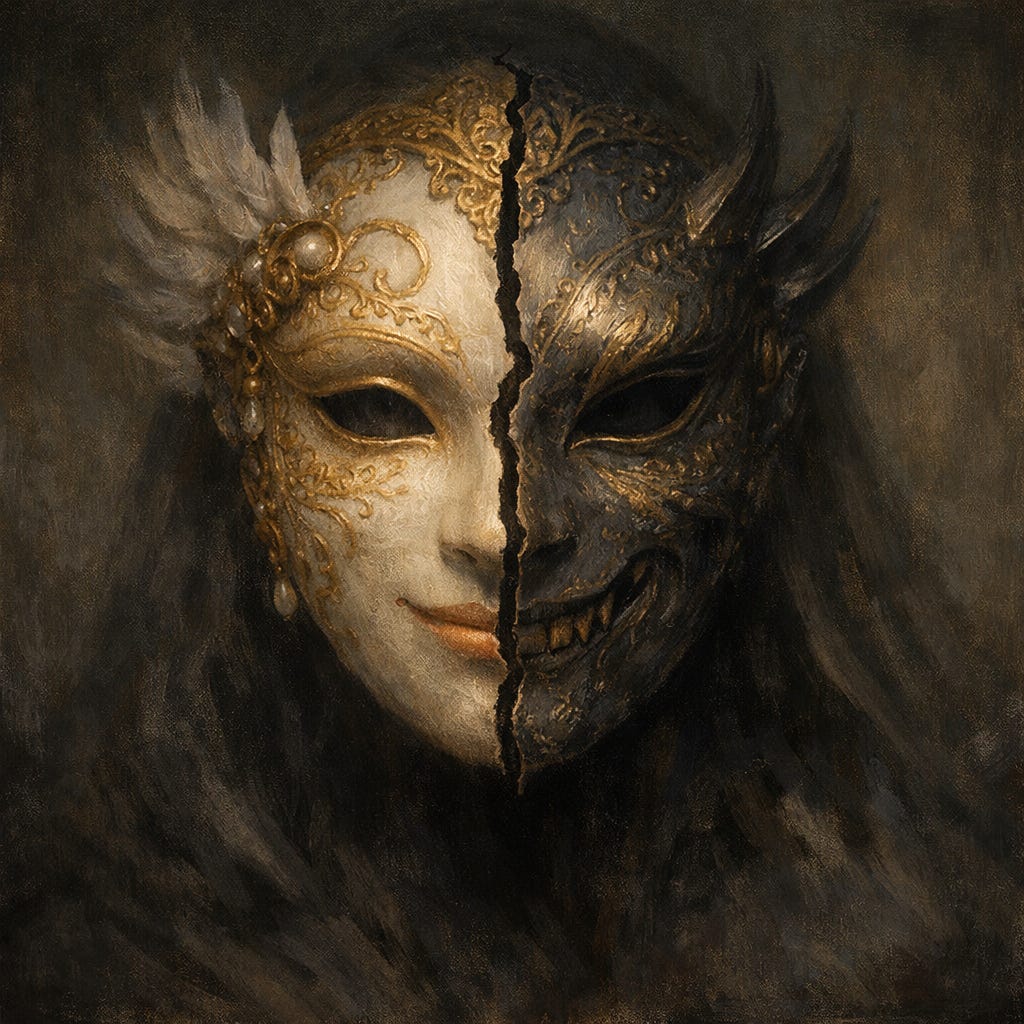
There is a quality even meaner than outright ugliness or disorder, and this meaner quality is the dishonest mask of pretended order, achieved by ignoring or suppressing the real order that is struggling to exist and to be served. —Jane Jacobs
Vicious Mirrors
The Seven Social Virtues have vicious mirrors. If we are to practice the virtues, we are to avoid the vices. The trouble is, vices not only masquerade as virtues, but they can also consume us through our dispositions and habits. To avoid the vices, we must first understand them. That means it’s best to look upon them as one might a deadly snake or spider—that is, at a safe distance. Variously, the vices are perverse manifestations of Evil’s Trinity: Decadence, Control, and Nihilism. What makes the vices so insidious, though, is their shapeshifting natures, which allow them to hide in the heart and twist the Logos.
It’s not enough to present lexical definitions. We must reveal the vices’ power to trick, tempt, and trap. The following are vices we must understand and avoid.
Violence
To harm someone in her body or property, whether through threat, destruction, or constraint.
Because it is sometimes a necessary evil, violence is arguably the most difficult of all to assign limits. Violence is vicious when initiated against the innocent. When we use it in defense or retaliation, it can be justifiable. In war, matters become even muddier. For now, let us consider violence in peacetime.
We have called enemies those who would commit acts of violence against our persons or property. Once so designated, it is not always clear when preemptive or proportional violence is justified. One can argue that when an enemy has articulated a threat, defensive violence is warranted. But to what degree? When an authority uses various forms of threat and violence against us, perhaps feeling justified in the service of some external conception of the good—such as in enforcing an unjust law—at what stage is it permissible to revolt? Possibility trumps permissibility, of course.
Violence is never virtue, but it is not always vice. At least we can say that no one should use violent means directly against the innocent as a means to some purportedly good end. Such is nonviolence. Around that boundary, at least, we must build our practice in thought, word, and deed, acknowledging that cultivated hatred or rising anger can plant thoughts of bloodying noses and smashing teeth in our minds.
Corruption
To lie to ourselves, dishonor our commitments, or engage in self-dealing.
Integrity’s vicious mirror, corruption, reflects a cluster of subsidiary vices, such as dishonesty, double-dealing, or disrespect for another’s time. Individual acts of integrity—such as honesty and honoring one’s commitments—accumulate to create a society of trust. Similarly, the structural integrity of a whole building depends on the strength of each beam, joint, and truss. Individual lapses of integrity accumulate to risk social decay. Whether people start to normalize tardiness to meetings or the taking of bribes, corruption can spread and corrode.
In many places, corruption infects the whole of society. For example, if bureaucrats, police, or functionaries position themselves between essential interchange points, ordinary people learn to accept and participate in an informal system of bribery to conduct the basic business of life. It’s critical to see how corruption can become an infection that enervates and immiserates a society. Whenever one is in a position or office that allows her to act with impunity, whether at the highest or lowest echelons, she will be tempted to wield her authority in the service of vice—especially if everyone else in her position is doing it.
Callousness
To show cruelty or indifference to suffering.
The further a human counterpart is from embracing the Unquestionable Answers, or from joining up with enemy Egregores, the more likely one is to otherize him. Othering can be a necessary evil, too, but it also risks making one callous. If one becomes cruel or indifferent to suffering, she risks becoming that which she hates. It can be difficult, nigh impossible, to become a model of virtue in the face of one’s enemies. Indeed, it can even be unwise to practice compassion during combat. Still, in equipoise, one must do one’s best to strike a balance between errant compassion and unnecessary callousness when under threat or siege.
Some say Jesus's teachings create an unresolvable tension—that cruelty is sometimes tragically necessary but never fully righteous. The Christian must act in a fallen world while knowing his actions fall short of the ideal. Must they fight without triumphalism, with sorrow rather than hatred? Vexing questions bedevil those who would turn the other cheek. But they bedevil all of us. If someone takes a deadly action against an innocent person, it is not callous to kill the offender.
What about those whose life choices have pushed them into the life of a derelict? Is our compassion misapplied when we invite such souls to camp on the high street? Surely such compassion worsens their condition and ours. So, our default position ought to be to practice compassion until compassion is clearly counterproductive. But that doesn’t mean we ought to cultivate callousness instead. Doing so risks awakening a monster that lives in the Shadow—a monster that makes one dangerous to his siblings.
Monomania
To adhere zealously to The One True Way
Monomania is an unhealthy obsession with a single means to a single end. While there is no One True Way, some zealously adhere to it at others’ expense and to the exclusion of other ways.
What about the Unanswerable Questions? one might ask. Are we siblings not zealously to adhere to the Law of Consent? There is a difference between a rule that opens a thousand ways and a way that forecloses all other ways. Even a rule as simple as Travel on the right—while it restricts our freedom to travel on the left—makes it possible for innumerable travelers to make their way safely to countless destinations. By contrast, if a tyrant insisted everyone travel to the city center, chaos and gridlock would ensue.
Monomania can be tempting.
To resist its temptation, one must operate with humility, open one's mind to experimentation and therefore to surprising results, and allow others to live their own little experiments so long as they threaten no one. The fixations of monomania can lead one to compel others to help realize ends they wanted no part of.
Negligence
To fail in caring for one’s property or offices.
Private property is one of the most fundamental institutions in our order. Wherever we have made an implicit reference to private property, let us make it explicit here. Respect for the difference between mine and thine brings peace where we might otherwise fight over unowned property. We also know that entrepreneurial production and trade are good within the context of reciprocal property protections, undistorted prices, and a system of profit and loss. But there is no exchange without private property. Nor are there undistorted prices. The socialist calculation debate is over. Private property is a precondition of a healthy market economy.
But private property carries a set of ongoing responsibilities, a virtuous practice we call stewardship. When we fail to be good stewards, we leave behind less bountiful, less useful detritus. It’s not merely that we risk leaving degraded property or offices to posterity. We also risk failing in the most basic commitment to tikkun. The sages remind us that we cannot take our belongings with us in death. Our stewardship, like life, is temporary. But when we are negligent, we overlook necessary maintenance. When we overlook necessary maintenance, we leave behind material conditions that reflect a disordered spirit. Social decay prevails.
Casuistry
To apply a fallacy or deceptive reasoning
Members of our order are committed to truth tracking, even when our enemies are fond of using fallacies, deceit, or deceptive reasoning to create powerful Egregores. Casuistry, which is the vice of either communicating falsehood or communicating with falsehood, tempts us, too. But we must resist. One might think that casuistry is like violence, that is, sometimes a necessary evil in retaliation. But refusing to live by lies not only separates us from our enemies, the truth almost always finds its way into the light. Deception eventually unravels the deceiver’s plans. Unreality and illusion are like dark spells that eventually dissipate in truth’s radiance.
It might seem that those who live by lies have an asymmetric advantage over those who do not—and such can be the case in the short term. But casuistry is unsustainable through time. Lies unwind enemy designs. And casuistry, even when its practitioner tells no explicit lie, obscures truth and blurs perceptions. The secret of subversive communication is our commitment to truth tracking.
Injustice
To deal unfairly with the innocent.
Take great care. Fairness is one of those areas in which injustice wears the mask of justice. Our enemies will equivocate when it comes to fairness, because there are at least two conceptions of fairness one can employ—but one is permissible, one is not. The acceptable form of fairness is proportionality. For conceptual ease, let’s assume two people are doing the same type of valuable work, so each produces the same value per unit of time. But if we observe that Person Two works twice as long as Person One, then Person Two is entitled to twice the reward according to justice as proportionality.
Yet those committed to justice as equal outcomes commit to injustice. Under this theory, also called social justice, Person One and Person Two are entitled to the same reward. Indeed, under a graduated tax system, Person Two is compelled to redistribute a portion of her higher reward to Person One, even though she worked twice as much. It is hard to justify this quasi-slavery. So in our order, we do not. Instead, Person Two might practice compassion and freely choose to give aid to Person One. But that aid might not come in the form of a financial gift. Instead, she might offer advice, such as Work longer or smarter for greater rewards.
Purveyors of injustice, such as politicians, will twist themselves into rhetorical knots to justify fairness as equal outcome (equity). But they must laud and practice multiple vices to do so.