


If you’d told me even a decade ago that I’d be attending synagogue, I would have been skeptical. If you told me I’d be presenting, I’d have thought you were nuts. Yet this past weekend, I gave the following presentation at a nearby conservative synagogue. The rabbi was to be away at an event, so she couldn’t teach the adult education group that convenes there.
Despite being a goy, I volunteered to give a presentation on Kabbalah, as the group had been exploring conceptions of God. Graciously, the rabbi agreed. And folks turned up.
The Sunday group was curious, warm-hearted, welcoming, and very engaged.
I hope you don’t mind my sharing this with the Grey Robes—MB
Before we get into Kabbalah, we need to set up two ideas.
The first is a debate that theologians have been having for centuries: Is God transcendent—distant, separate, and wholly other? Or is God immanent—inherent in all things, and flowing through us as nature itself?
It turns out, as we’ll see, that the Kabbalists had a pretty elegant answer to these questions.
The second idea is the Unity of Opposites. Day and night. Hot and cold. Young and old. These feel like opposing categories, but there’s something philosophically interesting going on: opposites are always defined in relation to each other. They’re inseparable, so interdependent. There is unity in opposition—a fundamental complementarity.
Now, keep both thoughts in mind as we continue.
Reimagining Genesis
The Kabbalists—Jewish mystics whose thought flourished in the Levant, and later in medieval Europe—offer a fascinating account of what happened before creation. Not the creation of the world, but the very first moment of anything at all.
Pre-creation. Pre-cosmos.
First, they say, there was Ain. Nothingness. The void.
From the void emerged Ain Soph—literally “without limit,” that is, the Infinite and Eternal. (Notice what just happened: from absolute nothing came its perfect opposite.)
And from the Infinite and Eternal radiated Ain Soph Aur—the Divine Radiance. This force emanates from the eternal source.
Ain,
Ain Soph,
Ain Soph Aur.
The Void, the Infinite, and the Divine Radiance. Three in one. The Kabbalists, without quite advertising it, gave us a trinitarian God.
I’ll be here all night, folks.
[They laughed.]
In our original framework, Ain Soph is transcendent—infinite, beyond all categories, and unknowable by mere mortals. Ain Soph Aur is immanent—it radiates outward, flows into the world, and dwells within things. Transcendent and immanent. Not either/or, but both/and. Another unity of opposites, just like the Void and the Infinite.
Syncretism
Where did these ideas come from? In a word: syncretism—the hybridization of different philosophical and religious traditions.
The Kabbalists were inheritors of a long conversation between Jewish thought and Greek philosophy, and the results are remarkable.
Start with Plato. His theory of Forms proposes that behind the messy, imperfect world of our senses lies a higher realm of eternal, ideal archetypes, such as Beauty, Justice, or the Perfect Circle. This is one of the most powerful ideas in Western Philosophy.
Of course, Plato has his critics.
The philosopher Sidney Morgenbesser once made fun of this idea by taking his students to a restaurant. If you’re a Platonist, he told them, you can only order Soup. (You can’t order the tomato bisque or the clam chowder.) You have to order Soup—the ultimate Form. Tomato bisque is but a fragment, an imperfect instance of the eternal.
I dare say Morgenbesser wasn’t a Kabbalist. Kidding aside, though, Platonists see the world as a cascade from unity into multiplicity, from the universal into the particular.
Plotinus
Now fast-forward from Athens to Rome, and meet the Egyptian-born philosopher Plotinus, who served up what we call Neoplatonism. In other words, Plotinus took Plato’s Forms and pushed them further. He proposed a supreme principle he called The One—an entity so fundamental that you can’t even say it is “good” or “beautiful” or even “existent” without limiting it by category.
The only way to approach understanding The One is through negation: “not this, not that.” This and that are but fragments of a higher-order unity, mediated by our imperfect, time-bound minds.
Sound familiar?
Plotinus’s One doesn’t just sit there, either. It emanates. It radiates outward in a kind of cosmic overflow.
The first emanation is the Nous, the Divine Mind, where the eternal Forms reside.
The second is the Psyche, the Cosmic Soul, where those Forms begin to differentiate into categories, sequences, and multiplicity.
The third is the Sensible World — material reality, where forms are fully fragmented into the individual things around us. (Morgenbesser’s tomato bisque.)
And yet, through it all, there is unity in diversity. The cosmos is a single entity expressing itself in many ways.
This is called monism.
But syncretism cuts both ways.
Interestingly, the second-century philosopher Numenius of Apamea, an important forerunner of Plotinus, once asked: “What is Plato but Moses speaking Greek?” He meant it as a compliment to both. Ideas flowed in both directions across the ancient Mediterranean—with Jewish thinkers absorbing Greek philosophy, and Greek philosophers absorbing Jewish theology.
When the Kabbalists eventually arrived, they were building on centuries of cross-pollination—of ideas having sex.
The Shattering of the Vessels
Back to Ain Soph Aur—that divine radiance emanating from the Infinite.
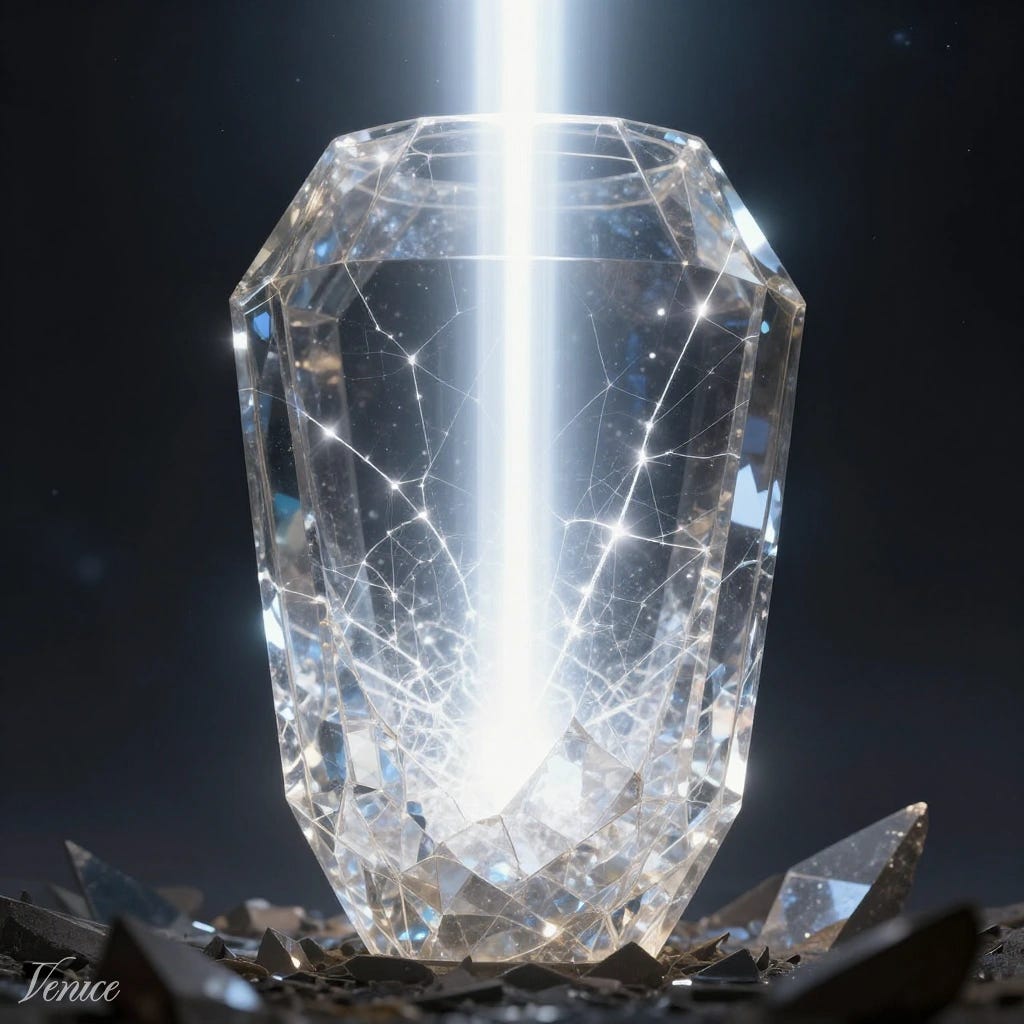
If Ain Soph is going to generate a world, that radiance needs containers. Vessels—kelim in Hebrew—that can hold and differentiate the divine light into higher-order categories. Think of them as like Plato’s Forms, the archetypal structures that shape reality, only rigidly.
But here’s the problem: the Divine Radiance is too powerful.
The vessels can’t hold it. They shatter.
This is sheverat ha-kelim—the shattering of the vessels. The cosmic catastrophe at the heart of Kabbalistic cosmology.
The holy shards scatter throughout the cosmos. They compose the physical world we inhabit. When those shards are ordered and harmonized, we glimpse goodness and beauty. When they become more disordered, separated, scattered—that’s what we experience as suffering and evil. Not evil as a positive force, but evil as privation, as fragmentation, as things being more broken, separate, and disharmonious than they ought to be.
And here is where it gets personal: we, too, are those holy shards. Glints of Ain Soph Aur flow through each of us. The divine is not only transcendent and remote. It is immanent in its nature, flowing through you, me, and everyone we encounter.
What We Are Here to Do
This is where the Kabbalists arrive at something genuinely beautiful.
We carry the shards of the vessels, and thus the divine sparks.
We also have freedom—and freedom, amid all this fragmentation, means we are imperfect and error-prone. We are not perfect. But we are holy. And that matters.
Ain Soph stands outside of time. But its emanance (Ain Soph Aur) flows through us as instruments of a cosmic purpose.
That purpose is what the Kabbalists call tikkun — repair. Hence, tikkun olam. The call to repair the shattered world.
Yet the goal of tikkun is the harmonization of difference—not the elimination of multiplicity or a return to perfect unity. We are not trying to force everything back into an undifferentiated whole, to put back the vessels, or find our way back to the void. Instead, we are charged with reordering the shards toward greater coherence, greater beauty, greater justice.
Harmonization doesn’t create a perfect world—but a more perfect world than this one. For our posterity.
And when our children inherit that better world, they too will practice tikkun. And their children will inherit what they build. Generation after generation, holy sparks reordering themselves and each other, never perfect, but always better.
We are, as the Kabbalists understood matters, the cosmos reflecting on itself, then repairing itself.
Worthy of Reflection
As shards of broken vessels, we are capable of reflection. Here are some questions we can reflect on today:
How does this account of pre-creation and creation compare to what cosmologists tell us? (Are the parallels—void, singularity, emanation, expansion, complexity emerging from simplicity—more than coincidental?)
What does it mean to carry the divine spark of Ain Soph Aur?
How does that change the way you see the person sitting next to you?
And perhaps most practically: how do we practice tikkun every day? How do we reorder the holy sparks—first in ourselves, then in our families, then in our communities?
For the Kabbalists, that’s not just a theological question. It’s the whole point of life. Because, in the process, we can become closer to Ain Soph. We can experience a modicum of Ain Soph Aur’s compassionate presence—enough to fill us, but not shatter us. And we can try to find a little bit more joy in practicing tikkun together.