


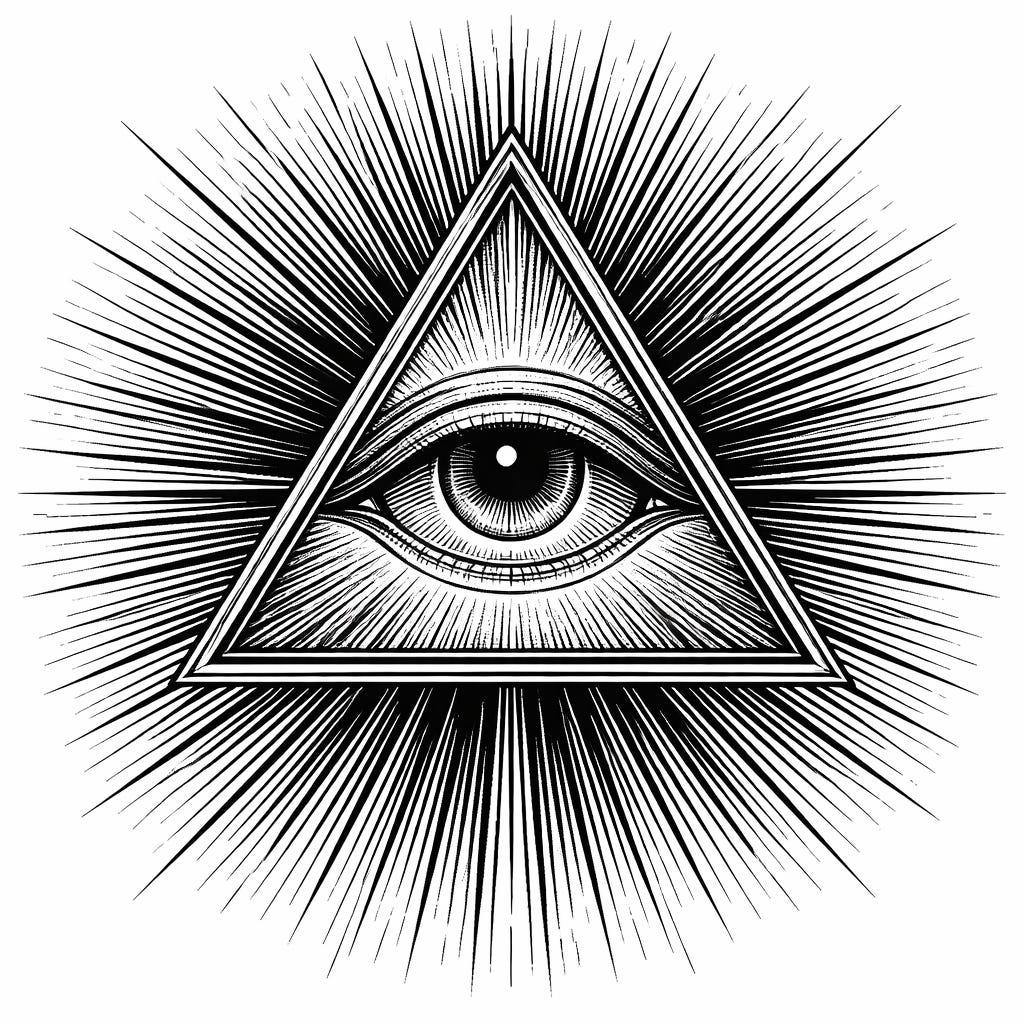
A serene eye, nested within a triangle, figures prominently in Masonic symbolism. Outside the triangle, artists sometimes render bands originating from the Eye, which represent a Supreme Being’s radiance. While we are a distinct order, we appropriate this symbol and make it our own.
For our purposes, we can break the symbol down into its constituent parts, explain each part, and then put it all back together again as a symbol fit for our order.
Three Sides
First, we shall break down the familiar equilateral triangle, which doubles as the Greek letter delta. The triangle is composed of three equal-length lines, each symbolizing an important feature of our siblinghood. Because each side is of equal importance and constraint, which side represents the base is not basic, but relative, just as the front of a Necker Cube is also the back.
Simply said, the sides appear in no particular order: Religio, Fabula, and Spiritus. Latin is superior to English in this context because the root words are closer to what we intend to invoke with each side of the triangle.
Religio is the force that binds individuals into a community.
Fabula is the story we tell about ourselves that ensures continuity over time.
Spiritus is our experience of the ineffable, which is the mysterious breath of life.
Now, we can reassemble these parts as sides to form our delta. Each side is vital. Each side constrains and reinforces the others.
Consider also that each side has a primary modality, which is to say, a communication vector. We pray you will forgive Greek being paired with Latin.
Religio’s primary vector is Logos, as it offers reasons and structure that bind.
Fabula’s primary vector is Mythos, which offers timeless truths beyond the literal.
Spiritus’s primary vector is Pathos, as emotion animates us with qualitative consciousness.
Again, each enables and constrains the others.
When outsiders say they are *spiritual but not religious,* they seek to feel without thinking, or to experience the sublime without solidarity with others or commitment to doctrine or mythic truth. In many cases, we would say this is incomplete. In others, it is but emotional onanism.
The same can be said of the other sides that compose the delta. A religious order without spirituality is like a temple without prayers or the prayerful. A story without feeling is just a schematic in a sanctuary. Congregants without a story are but a bacchanalia or a bureaucracy.
The Delta and the Eye
The delta, once formed, symbolizes elements that are resistant to change. Strange, then, that term delta indicates change. So be it. We are comfortable with paradox. We are also comfortable with the Unquestionable Answers and the Unanswerable Questions existing together in that dynamic tension that impels us as a siblinghood.
The delta of our order integrates change into the unchanging.
Then, of course, our delta (triangle) includes that which lies within and that which lies without, and together they form a unity of opposites, symbolizing the sacred and the profane, as well as the esoteric and the exoteric.
What can we say about the Eye, with its silent repose, its sight beyond sight?
Most of us, excluding pirates and Polyphemus, have two eyes, one on the left, one on the right. When we open our inner eye, also called the third eye, we imagine a third point above the head, which the Hindus call the crown chakra. When we connect the three pupils, we discover three vertices, which recreate our delta.
Opening only the left eye lets one see only two dimensions.
Opening the right eye with the left eye reveals three dimensions in stereo vision.
Opening the inner eye reveals nonduality and multidimensionality.
This can be a powerful experience. It awakens the entheos. But we must never confuse such insight with infinite sight—the omnipercipience of the All. To become a psychonaut, reckoning with nonduality and multidimensionality, is like an astronaut hurtling towards a single star in the spiral arm of a single galaxy, amid a billion galaxies, yet thinking he holds the keys to the cosmos. To reckon with such insight is to allow an infinitesimal fraction of Ain Soph Aur—the radiance of Ain Soph, the breath of the All—to flood your being.
In the top Tier of Joy, we touch the transcendent, if but for a moment, but that is as far as we can go in this life.
One’s inner eye is like a porthole opening to the deepest ocean. While it is indeed an aperture into the All, it is small, revealing just a glimmer. Perhaps we risk anthropomorphizing the All when we imagine the Eye as belonging to the countenance of Ain Soph. Yet we know, along some dimension, that our consciousness is the cosmos regarding itself. Deep within the bounds of Religio, Fabula, and Spiritus lies a mystery. And when we are ready to bring head, heart, and gut into alignment, we can start to open our inner eye and stare into the mystery.
But we must prepare for the possibility that one day it will stare back.
Sierpiński’s Secret
The delta contains multitudes. We have written that our telos is tikkun, where ongoing repair is work towards the harmonization of difference—expressed as organic unity. So our Radiant Delta, plucked from the arcana of our forebears, when viewed from within, reveals a recursive reality.
1, 3, 9, 27, and so on to infinity, complete with as many eyes as insights.

In the case of the Sierpiński gasket, depicted above, mathematics is metaphorical. For those disposed to logos, we appeal to the left brain to activate the right. We hope it helps to open the inner aperture. Suffice it to say that the experience of Spiritus is not just a feeling, but almost always a fractal manifestation.
Thus, we arrive at a signpost: the Radiant Delta is not merely a symbol to be decoded, but a living geometry through which we decode ourselves. As we trace its sides—Religio, Fabula, Spiritus—we discover they are boundaries that both limit and enable us, where each opens onto the others in endless recursion.
The fractal nature of our symbol reminds us that every insight contains worlds within worlds, every answer births new questions, and every time we think we have grasped the whole, we find we are holding but one triangle in a vast tessellation. To engage this symbol is to commit to a journey without a destination, a traveller’s telos—to embrace the paradox that we are simultaneously the observer measuring the delta, the mystic dwelling within it, and channeling a radiance from beyond.
In this recognition lies our most essential teaching: that the work of tikkun—of repair and harmonization—begins not when we fully understand the mystery, but when we accept that we are, ourselves, a part of it. The Eye within the Delta watches, and we watch back, and in that mutual gaze, the All contemplates itself through us, as us, forever.