


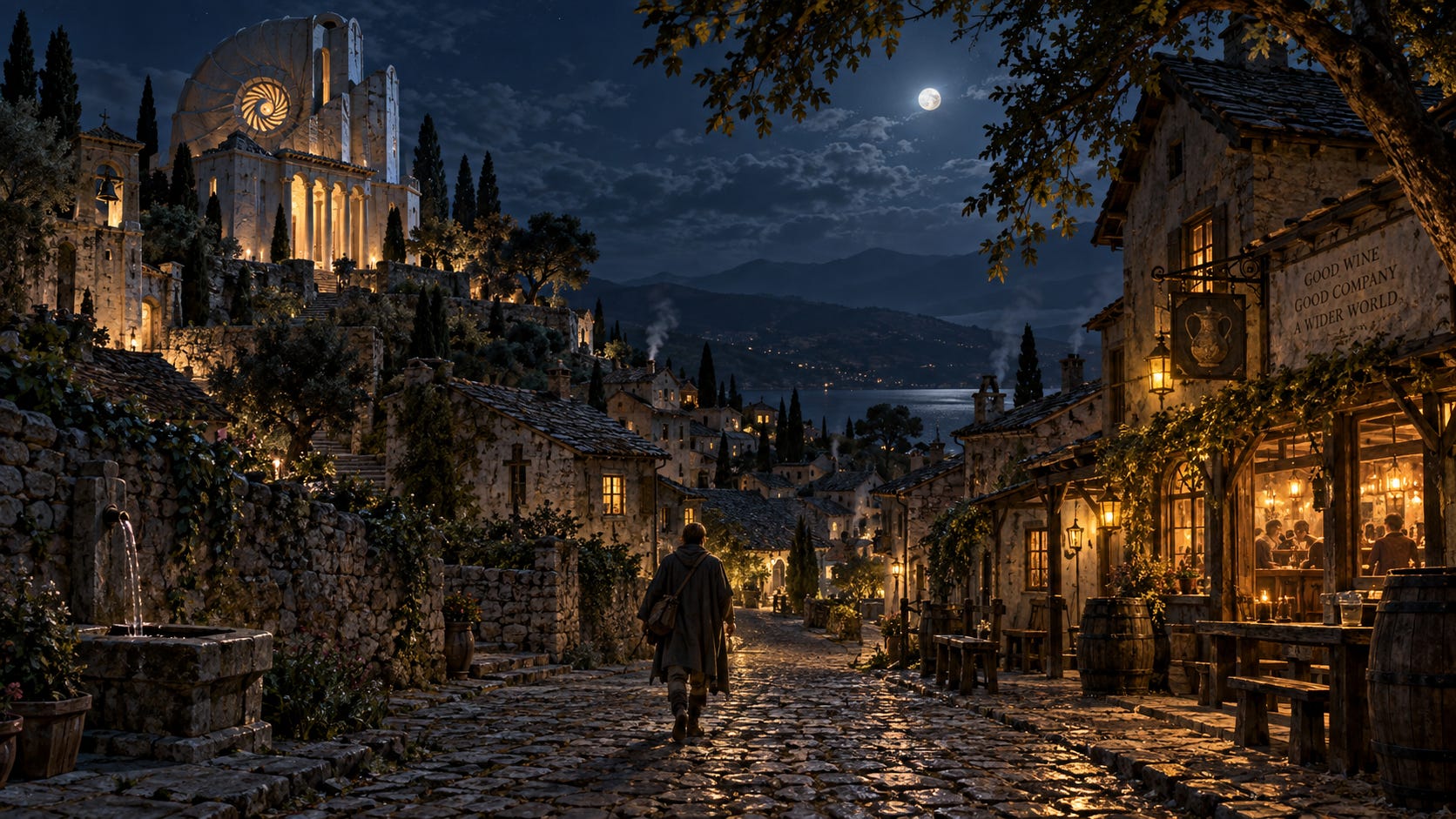
A traveler comes upon it from the south, where the road bends through a stand of old elms. He sees the temple first, as everyone does. Its strange architecture catches the late sun as if breaking through a dream. But as he descends, the rest of the settlement comes into view, scattered down the slope like blooms from seeds thrown by a generous hand. Slate and clay covers the roofs like lichen. Smoke rises.
Someone rings a bell by hand.
The main thoroughfare runs east to west. The temple stands on one side, the tavern on the other. No one planned this, and yet even the traveler knows it could not be otherwise. He reckons that inside one there is an adyton, and inside the other there is a room at the back.
Next to the tavern lies an inn. The traveler books a room, eats a modest meal, and goes to bed.
In the morning, the market burgeons along the thoroughfare. The fishmonger has set up next to the spice peddler. An old woman selling flowers, as if arrows in a quiver, tries to catch the eye of a bachelor. A boy selling apricots from a basket hollers near benches where the old men gather to argue and play dice. The old men sometimes poach his apricots, yet the boy permits this because they protect his wares, tolerate his hollering, and insist that passersby buy his fruit.
Sometimes there are disputes, but most are settled on the spot. Carters who quarrel over right of way are made to dismount by a witness, and they are obliged to cool down and talk the matter through under the closest tree. If the talk does not resolve it, the witness fetches an elder, and if the elder cannot resolve it, they call a steward of justice, who, hanging a shingle, charges them a sum that is usually greater than what it would have cost the parties to resolve the dispute with the witness or the elder.
Most disputes never reach a shingle. Most only reach a tree.
Customs vary from street to street, and this is good. On the shady lane, the families eat together at midday. On the windy row, they take supper at dusk. The weavers’ street holds a feast at every solstice, but the smiths’ street holds a feast at every equinox. Children move among the streets and learn early that there are many ways to live well, and especially to eat well.
On a corner where two cottage-lined streets meet, a woman kneels in the late afternoon, setting stones into a low wall. It’s not clear what the wall is for, though it could serve many purposes. It bounds a small bed of herbs, shelters the roots of an old tree, and surrounds the steps up to a path, then up to a cottage. It could protect a few, but no more. She works absorbed, the way children work when no one is watching, and her hands are muddy by the time she stands.
She brushes her hands on her knees and walks away.
After dark, the temple and the tavern show many lit windows. Murmurs issue from the temple, from those who have come to pray over magisteria inscribed in the floor. In the adyton, people shiver and cry out. From the tavern spills laughter, music, and bawdy talk. In the back room, people shiver and cry out. Sometimes, the souls in the temple and those in the tavern are the same, for a settlement that denied either would be a settlement built on a half-truth.
Once a week, a widow visits the well to cry. A young man keeps secrets in his room above the chandlery. Lovers stand in a doorway, forgetting the hour. An old gambler teaches the boys to throw dice, and the boys’ mothers complain they are out too late. None of this is hidden or celebrated. It is simply the weave of a place where the law prevents injury and leaves the rest to the living.
At midnight, a silhouette walks home along the thoroughfare. The temple is behind him on one side, and the tavern is on the other. Ahead of him is the path to his door, where someone has lit a lamp in the window and is waiting up.