


He didn’t recognize them anymore. The world he knew had shattered, and they were all but shards. Sometimes they cut. Whether he walked among the market throngs or sat alone in the forest, he felt alone.
In that solitude, he was hollow and anxious, surrounded by loud waves of change, fear, and anger. Sometimes he wanted to gasp and kick, thinking that soon he might tire of treading water, then fall into the deep and drown.
But a few, he saw, had turned back to the old ways—the books, the traditions, the places of worship. He had even gone to an old temple one day. Those he found there seemed to be clinging to the flotsam of something that had been broken up in a great storm. The congregants invited him to come back, but something in him—perhaps the restless stillness of anticipation—told him he could not.
One morning, something woke him just before dawn. As the first light began to paint the sky, something inside him mirrored it. And as the sun rose, he felt its warmth, within and without. It flowed through him, filling him with energy. Creative energy. A generative urge, yes, but a sublime warmth, too, as if his heart were a vessel capable of containing an emanation from the All.
The experience reminded him he was still alive.
He thought of going back to the old temple, but knew it was still freighted with its traditions, interpretations, and well-worn paths among the well-planned gardens and well-tended grave sites. Any new ideas would just stir up dust, and the old temple-goers are allergic to dust.
He thought of joining the angry mobs, but when they are not chanting slogans, they are bowing to the houses of power. Their plebiscite prayers are never answered by those who fancy themselves as gods. But their gods don’t create. They take and impose.
He thought of letting himself fall into the abyss where nothing is sacred, and nothing is real or true. There, at least, he might be able to ignore the cacophony, to determine that the world is just Sturm und Drang—ceaseless turbulence mistaken for meaning. But nothing could be created in the abyss.
Where could he go?
His solitude, along with the consuming radiance that filled him, would become somehow burdensome if he could not find the others and set to work. So he went back into the forest to reflect, where he hoped he might find an answer, at least, outside the cacophony of change, fear, and anger.
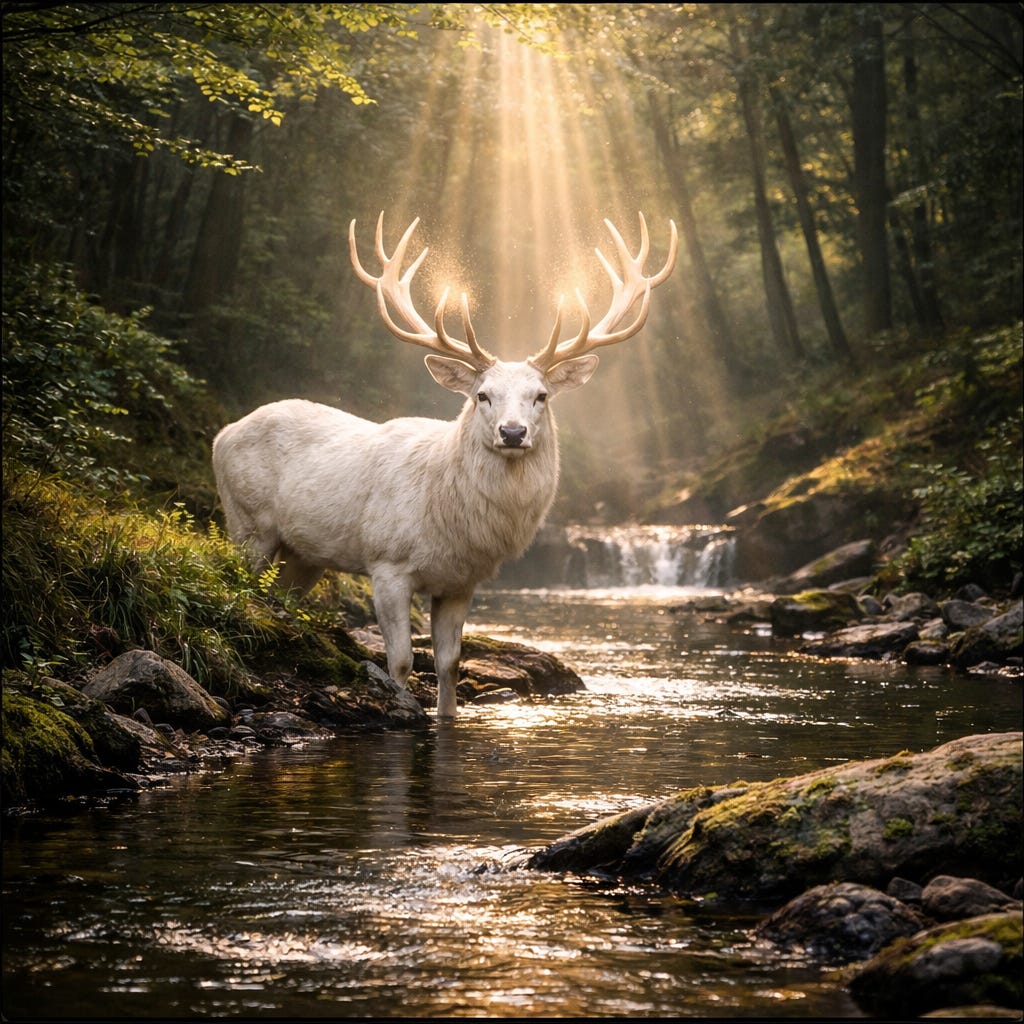
He went deep into the woods, where light shone in glimmers and shafts through the treetops. As he approached the forest stream, he discovered he was not alone.
A stag stood at the bend in the brook, drinking. It was large but unhurried, and the light that fell in shafts through the canopy seemed to gather between its antlers—drawn to them the way iron filings orient around an invisible field. The stag stopped. Then it raised its head and looked at him without alarm. It held his gaze long enough for him to understand this was not a chance encounter. Then the stag turned and moved along the bank—not in retreat, but intending to be followed.
So he followed.
The stream bent around a great oak whose roots had been bent by the brook and its bank over many years, pulling and twisting until they formed a natural, shaded hollow. Sheltered on three sides by roots, earth, and moss, it was open to the water and light on the fourth side.
The stag stopped at the tree and went no further.
Inside the hollow, a child sat with her back to him. She was stacking stones along the curved edge of the roots. She worked the way children work when no one is watching—completely absorbed. She placed each stone deliberately, building a modest wall. It could hold warmth, but not much. It could shelter a few, but no more. It was the work of someone enclosing the sacred against the profane, saying: Here, this place, for us, for now. She built it in the spirit one might cup a candle's flame.
The child turned and looked at him. She was neither surprised nor expectant. She looked at him the way one looks at a person who arrives exactly when they are supposed to. Then she stood, brushed her muddy hands on her knees, and walked into the trees, leaving the wall complete for him to admire.
The stag was gone.
He stood at the edge of the hollow for a long time. Above him, the canopy moved in a breeze. The stream flowed. He thought of the others—the ones he had not yet found, the ones who were perhaps standing at the edge of their own forests, waiting, wondering what they were waiting for.
There were eleven others. He would make twelve.
He envisioned a place where all twelve could gather, away from the cacophony and the waves. There, they would create something together, sheltered for a time in something modest and temporary, but holy.
He knelt by the water and picked up a stone.
A founding convocation is in order. If you're interested, please reach out.