


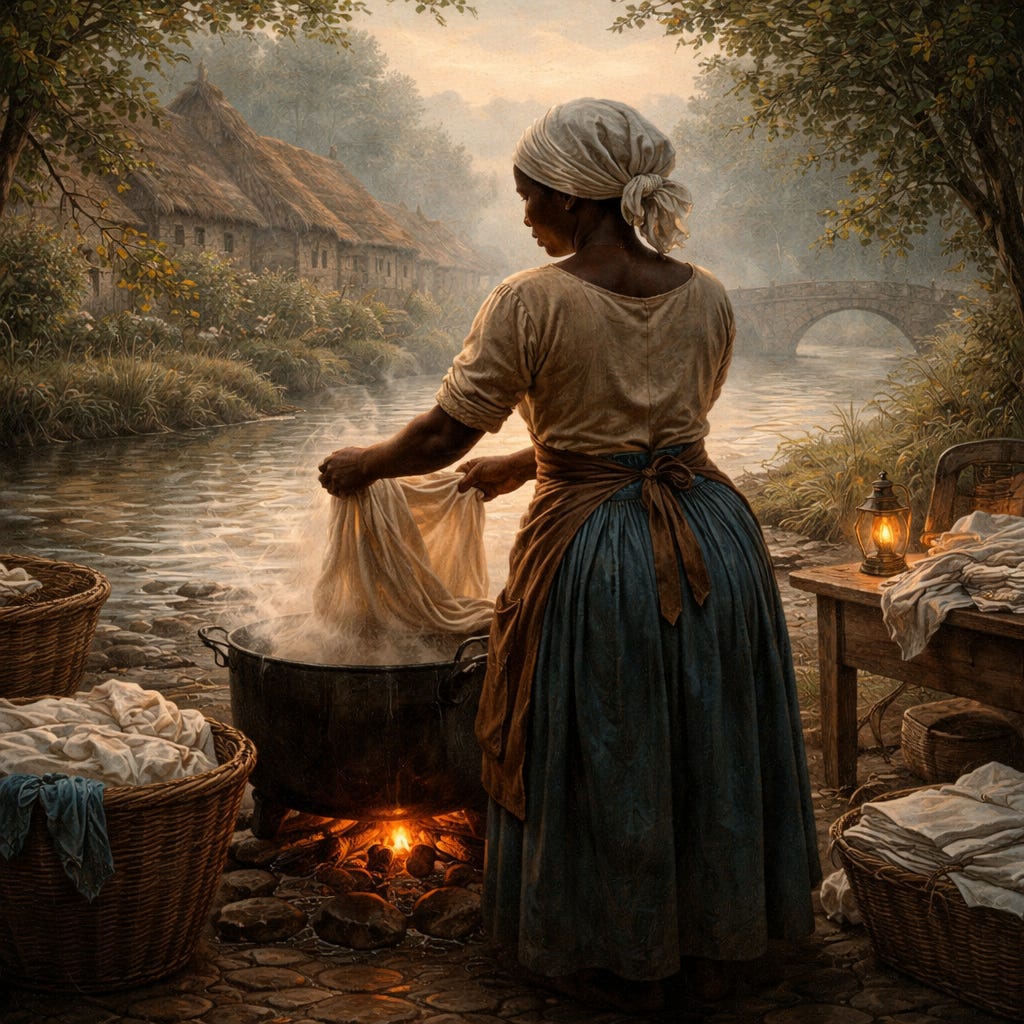
In a small village where the river bends, there lived a young Washerwoman who knew the world of steam and scrub, starch and press. Each dawn, she rose to light her washpot fire. Each night, she ironed until the stars blinked. Her brow knew sweat. Her hands knew the weight of wet clothes and the satisfaction of wringing fabric.
This was her domain. She was good at what she did, but a different fire burned in her heart.
As a girl, she had hoped to wear a nurse’s apron, to heal rather than clean. Necessity deferred that dream. Poverty’s arithmetic demanded she earn instead of learn. Yet the dream never died—it just transformed. If she could not become a nurse, she would have to do something else.
So, she asked herself:
What will you leave behind when the coals go cold?
The Washerwoman made a pact with time.
Every bit of surplus earned from her labor would be set aside, denied to present comforts, and saved for a future she might never see. For decades, she dwelt at the limen—physically in her river-bend village, but spiritually in a tomorrowland where formerly poor women in white aprons moved through the hospital to help people heal.
The work was Sisyphean.
Soak, wash, boil. Rub, rinse, wrench, and rub again. Starch and hang. Day after day, bundle after bundle, she repeated the same ritual thousands of times. Sometimes she worked for two or three days straight, the fire never going out. Her dry, cracked hands seldom rested. The wealthy folk whose clothes she pressed probably never thought about the woman who made their collars crisp. As the help, she was almost invisible, more a function than a fellow.
But they paid.
The Washerwoman held secret wisdom: She loved the work. The bright fire. Wringing out clothes. Tunics drying on a line. She had found what the philosophers call amor fati. While others might have been bitter, she grew rich in ways that had little to do with money.
By the time she was old, the Washerwoman had accumulated a small fortune. It had been built from modest coins and lesser denominations. Weary from a lifetime of work, she now faced her most significant test. This was money she had never spent on herself nor used for pleasure. It represented decades of effort.
To throw it away would be to throw away all the value she created and stored.
She could have lived her final years in considerable comfort. She could have taken trips or eaten dinner from fine plates on white tablecloths. She could have scattered it like seeds to random poor people with outstretched palms or begging bowls. But the Washerwoman knew a vital truth:
Giving well matters more than simply giving.
The Washerwoman established a scholarship fund for aspiring nurses. This was not errant charity, but it was directed toward the specific dream that had been denied her. The funds would not go to strangers, but instead to young women in her community.
She would be able to meet their hopeful gazes and see them beam with pride.
In doing things this way, the Washerwoman tapped into an ancient lesson. Good giving involves three elements:
Connection. Support something or someone important to you.
Choice. Select the most meaningful change vector to you.
Impact. Witness the positive results of your actions.
The Observers think that humans evolved to help people they could see, whose faces were familiar, and whose gratitude they could feel. The Washerwoman wasn’t giving her wealth to causes far away. She was shaping the destinies of poor village girls.
She made the world better than she found it.
The Washerwoman’s gift created ripples. The story spread. New donors quadrupled her fund. One wealthy merchant, humbled by the Washerwoman’s generosity, gave away a humongous fortune. She had unleashed a contagion of compassion. Her modest action came to symbolize the power and the joy of giving.
But even as an old woman, she wasn’t quite finished.
After the gift, she continued washing and ironing. The money was never the point. The work was always her dharma—doing for the purpose of giving. And with that, a humble woman from a small village on the river’s bend joined the pantheon of great philanthropists.
When the Washerwoman set down her iron for the last time, she had been transformed from a laborer into a legend. She had turned the mundane into the meaningful. The nurse she could never become was multiplied in the future. Her scholarship would create dozens, then hundreds of nurses. Hands that had scrubbed and wrung had also reached into the future to shape the destinies of so many.
Meaning is unlikely to be found in grand gestures or noble birth. Yet it can be found in the consecration of ordinary means toward extraordinary ends. Happiness derived from what we consume is fleeting and thin, but joy derived from what we leave to posterity is our measure of immortality.
Today, the Washerwoman’s washpot is cold. The fire is out. But somewhere, right now, a young woman in a white apron glides through a hospital ward, by a bend in the river, excited for her first day of work.
Beautiful story