



Some things yield to effort. Others yield only when we do.
The Will can carry us through hardship, discipline our appetites, and keep us faithful to a promise. But it cannot make us fall asleep, force an insight, or command another person to love us. A stubborn problem may demand another hour of concentration—only for the answer to arrive while we’re taking a bath. A difficult relationship may call for courage and candor, yet sometimes it takes greater courage to relinquish control.
How, then, do we know when to exert ourselves and when to surrender?
We speak of “I” as if one voice does the talking. Watch and listen, though, as thoughts, feelings, and instincts compete for our allegiance. These are the Executives—head, heart, and gut. Even when they come into equipoise, we must ask: Shall we exert ourselves upon the world, or open ourselves to what lies beyond our control?
Two Agents offer different ways of engaging the world. One acts and the other allows. But a third faculty, the Witness, serenely observes.
The Witness is the inner observer who regards the competing energies without directing or becoming any of them.
The Will is the power of conscious agency: to remember oneself, choose deliberately, and meet resistance without yielding the self.
The Willingness is the capacity to release the ego’s demands and consent to become an instrument of something greater than oneself.
One Agent follows the path of exertion. The other follows the path of surrender. The former resembles the left-hand path of profound self-mastery; the latter, the right-hand path of receptivity and devotion.
Neither path alone is sufficient.
Here lies a paradox. Neither Will nor Willingness can operate wisely without the Witness, yet the Witness alone can neither act nor surrender.
The Witness
The Witness observes thoughts, emotions, impulses, and identities without mingling with them. It is neither an Executive nor an Agent, but the still point from which all their workings become apparent.
It neither commands nor consents. It watches from a place apart.
It discerns rather than judges. The more it observes, the more clearly it reveals who or what is speaking—whether pride, appetite, conscience, habit, or aspiration. From this vantage point, time seems to slow, and the gap between stimulus and response widens.
In that gap, the Will can act, or the Willingness can open.
Yet the Witness is inert. It can find cowardice but cannot supply courage. It can see attachment but cannot let go. It can hear the call to surrender but remain unmoved. Such is its nature.
The Witness is clarity without command—and endeavoring to make it exert itself is to misunderstand it.
The Will
The Will is a capacity that grows with use, like a hand learning an instrument. It begins, refrains, persists, and returns. Its first jurisdiction is the self. A man who cannot govern his own appetites has no business governing anyone else’s.
The Will does not exterminate the lower self’s appetites or impulses. It organizes them, issuing small decrees:
This, not that.
Now, not later.
Enough, not more.
You see it when someone keeps a vow despite temptation, when a cheap retort dies on your tongue, or when your attention wanders and you consciously return it.
This is the discipline of self-remembering—becoming a conscious author of one’s actions rather than an automaton governed by habit, impulse, or circumstance.
But left unobserved, the Will can become an instrument of tyranny. It confuses control with freedom and suppression with discipline. Worse, the lower self can commandeer it, shrouding appetite in the language of purpose. When pride takes command, the Will marches forward on trampling hooves.
The Will that escapes the Witness cannot tell whose orders it is following.
The Willingness
The Willingness can be mistaken for passivity, resignation, or defeat. But it is the readiness to be changed, taught, emptied, or drawn beyond one’s usual borders. It is the state through which one receives transcendent experience rather than seeking to manufacture it.
Its fruit can be non-attachment, which has nothing to do with indifference. The non-attached person loves, grieves, and wants, but releases the ego’s demands. Willingness loosens one’s grip on outcomes, identities, pleasures, and grievances—and occasionally opens one to sublime states. But a sublime experience visits and courses through, rather than being seized, interpreted, or possessed.
In fear, grief, or bad habit, the ordinary self erects protective walls. Willingness is the paradoxical power of surrender that lets the walls give way. It creates nothing. Instead, it removes egoic obstructions and distractions.
But Willingness is not blind surrender. At its greatest height, it is conscious consent, and sometimes it takes tremendous agency to release what the ego insists on controlling. Unobserved surrender, by contrast, may bring us to our knees before the wrong powers. History is crowded with those who mistook dissolution for illumination, self-denial for enlightenment.
The Witness keeps Willingness lucid.
The Living Whole
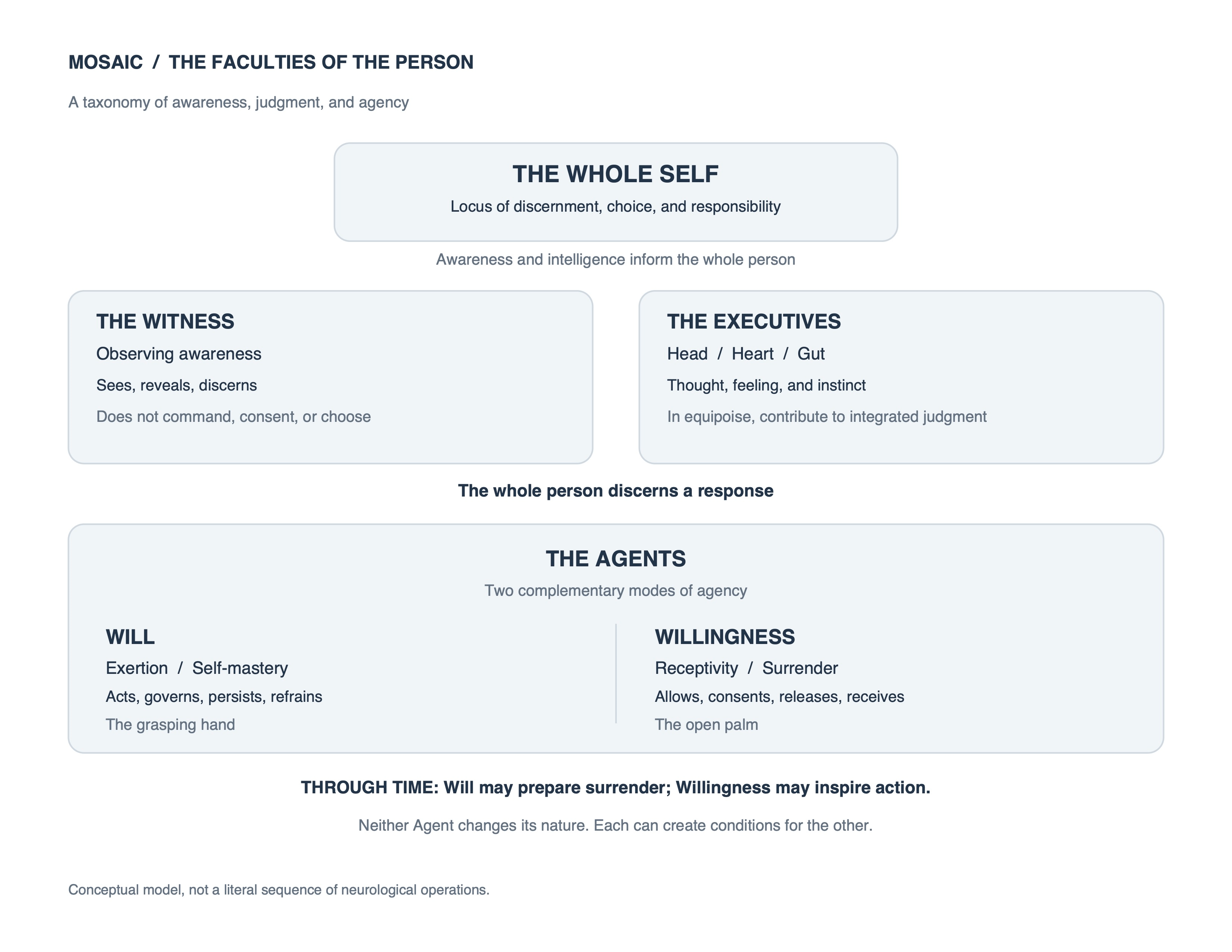
Neither Agent can exercise its powers wisely without the Witness. The Will must know what it directs, or it charges on impulse. Under the watchful inner eye, the whole person can distinguish a worthy pursuit from disguised desire. Likewise, willingness must know just what it consents to, or surrender becomes indiscriminate.
Under the watchful inner eye, one knows when to penetrate and when to receive.
Remember: The Witness does not choose between the Agents. It brings the competing motives into view without favoritism. When the Executives—head, heart, and gut—come into equipoise, their different intelligences contribute to an integrated judgment. The whole person can then discern whether the moment calls for exertion or surrender.
Each faculty has its part to play. The Will acts, and the Witness sees. Willingness surrenders, and the Witness watches. One might call the Witness the inner eye, the Will the grasping hand, and Willingness the open palm. The eye cannot grasp or release. Without sight, the grasping hand cannot know what to hold. Without sight, the open palm cannot know what to receive.
The Witness brings awareness.
Equipoise enables integration.
The Agents negotiate the response.
The two Agents need not oppose each other. An act of Will may prepare us for surrender, just as what we receive through Willingness may inspire us to act. Each can create the conditions for the other, as exertion gives way to receptivity, and receptivity to renewed exertion.
We are neither the force that strives nor the power that yields—neither the chittering thoughts nor the feelings that swell. Each of us is a whole in which these powers find their proper places.
The Witness observes, the Executives find equipoise, and the Agents give our choices expression.
Sometimes the hand must close around a difficult task. Sometimes it must open to receive what effort cannot grasp. And sometimes, what arrives in the open palm becomes the very thing we’re called to carry.