



We crash in the dark- - - - - - - - - - - - - - - - - - -
- - - in FITS AND STARTS - - - - - - - - - - - - - -
- - - - - - and, oh, that really smarts - - - - - - - - -
- - - - - - - - - - - - i know it’s gonna leave a mark
—Lee Schulteiss
With AI, the Uncanny Valley is morphing into the Uncanny World. Our visual and auditory modalities will continue to be dazzled by increasingly high-definition slop, but we will always crave connection, that distinct imperfection. If AI+UBI eventually turns most of us into human housecats, some of us will still want to know the dignity of work. And if some of us own robots or have a stake in these bizarre, futuristic means of production, there will still always be a desire for the human touch.
We’re more compelled by artwork when the artist has a reputation, when we have a context for the piece, or when we know the backstory. We are willing to pay $20 for the simulacrum of hand-blown glass, but we might add a zero or two if we know that an artist toiled with molten silicon and used his own breath to create the form. The same can be said for paintings, craft dolls, and metal sculptures.
Stuff just isn’t that interesting anymore. It’s stuff plus experience.
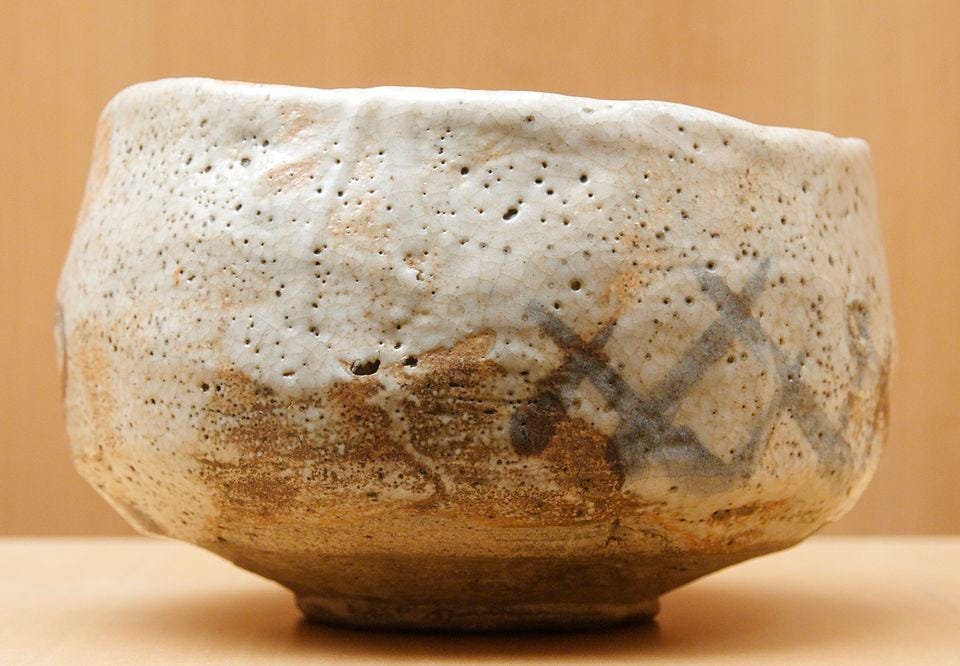
Often, these items are imperfect. In fact, relative to what a machine might produce, each piece could be uniquely flawed. According to Japanese lore, a young man named Sen no Rikyu sought to learn an elaborate ceremony called the “Way of Tea.”
Rikyu went to the tea master Takeeno Joo, who tested the student by asking him to tend the garden. Rikyu cleaned up everything and raked the garden until it was immaculate. He scrutinized everything to be doubly sure. But before presenting his work to Takeeno Joo, Rikyu shook a cherry tree, which caused a few flowers to fall randomly—imperfectly—onto the ground.
According to the Japanese tradition of wabi-sabi, Rikyu understood the true nature of the aesthetic. There is beauty in imperfection. And there is something interesting about the fissures in wood, the crack in a bowl, or the randomness of a splatter.
Natural-living enthusiast Robyn Griggs Lawrence agrees:
Wabi-sabi understands the tender, raw beauty of a gray December landscape and the aching elegance of an abandoned building or shed. It celebrates cracks and crevices and rot and all the other marks that time and weather and use leave behind. To discover wabi-sabi is to see the singular beauty in something that may first look decrepit and ugly.
Of course, it’s not impossible for an artificially intelligent artist to iterate endlessly on patterns of aesthetics that most people tend to like. And indeed, many fine-looking designs might come straight from AI, developed perhaps as amalgams of popular designs from the past.
But for many things, human beings will not want the popular or the amalgamated. We will want the uniquely beautiful, interesting, novel, or compelling art forms because we have imbued them with our humanity. We will want many things wabi-sabi because they mirror our imperfections. And experience will surround our goods like narrative metadata.
Now, what about the cracks in us?
Our imperfections are a part of what it means to be human. It’s one of the reasons we call ourselves grey. Far from drawing from the dark forces around us, grey is, in one sense, an acknowledgement that we are not just imperfect, but that we are separated from the eternal—from what might be considered perfect by some supreme being who, if he/she created us, gave us freedom, which is so easily abused.
One of the types of cracks in us—whether in mind, body, or spirit—is our scars. Our healed wounds sometimes indicate that, in our effort to improve the world around us, we get hurt.
Life is hard.
My wife is friends with a group of old rockers called the Drive-by Truckers. And in one song, the frontman sings two apparently contradictory things, namely that “it's gonna be a world of hurt” and “it’s fucking great to be alive.” Amid the raucous guitars and drums without click tracks, my wife finds redneck wisdom and pure poetry.
She finds wabi-sabi and scars.
She and the band remind us to look around at the broken world and set about fixing it. In doing so, we will not only find that life is worth living, but also that it is worth living because we are capable of overcoming all the pain, sadness, and failure that being free and imperfect brings.
Thank you!