


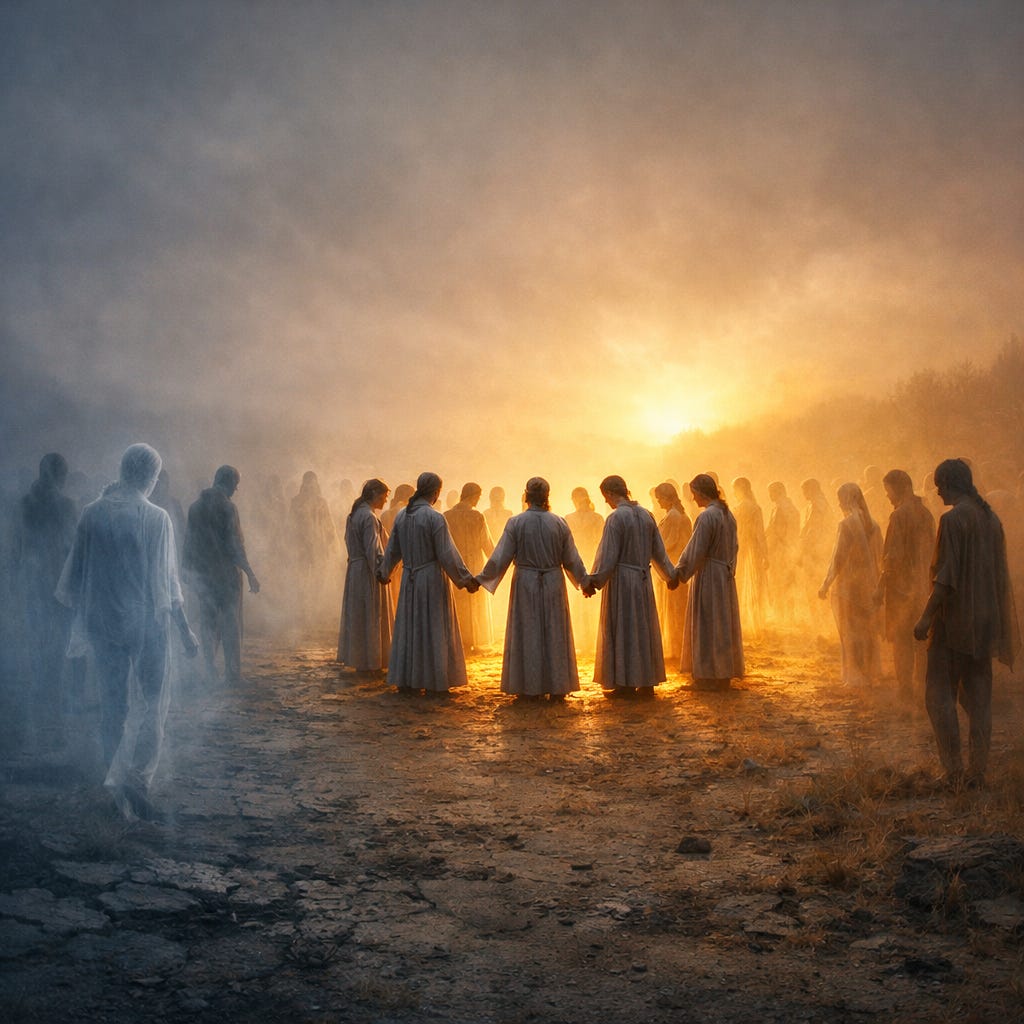
It will come into existence when enough of us see what it can be and are ready to commit to its becoming. For many, that will take accepting that their societies have become fractured and factionalized. Others will conclude their once-great civilizations have become decadent and disordered, that their communities have become rootless and their spirits aimless as they haunt the material world.
Too many live without binding agents, which makes them weak and vulnerable.
Our order shall form in the blessed tension between the Unanswerable Questions and Unquestionable Answers—inquiry and doctrine. The former supplies us with a measure of spiritual nourishment and, occasionally, of wonder. The latter offers us a star around which to orbit, a sense that we coalesce around a certain set of commitments.
Every Summer, for example, our order must recommit to its Mission: to organize so as to form a society of consent—a polity without the politics of domination. Behind this mission, we set out the brutal game theory of the protection racket. It explains life under Pharaoh, or Caesar, or George III. Since the time of brigands and planters, this protection racket has persisted throughout the ages, freighted with pomp, circumstance, and self-congratulation.
But if we are to escape Pharaoh, we have to change the collective consciousness of a people. We have to awaken a Geist. We have to build an Empire of the Mind.
But a consent-based social order does not exist, the skeptics will say.
Yet, we shall reply. That is why we exist, among other whys.
Our mission is to midwife a polity, just as the Greeks developed democracy, the Romans built a republic, and the Americans introduced the first constitutional republic. Though men such as Thomas Jefferson, Robert Yates, and George Mason were all worried that the 1787 Constitution risked forming an authority that would overshadow a person’s rights to “Life, Liberty, and the Pursuit of Happiness” as well as the “consent of the governed” meant to secure those rights, the American Founders instituted something more ideal than what had preceded it.
Eventually, their polity mutated into an extractive empire before it could celebrate a quarter-millennium. Yet Jefferson, Yates, and Mason, who had warned against the consolidation of power, possessed wisdom and foresight from which future generations could draw. Echoes of their Geist persisted, as did those of the Greek and Roman Geists, and of Persia and Israel.
Yet for imperfect ideals and their imperfect instantiation mediums, people were willing to kill and die.
They still are.
As it is proper in Winter, our thoughts should turn to death. The question before us, then, is: For what should we be willing to kill or die? The answer should be the same as that to the question: For what should we be willing to live and create? Surely the answer has to do with the Pursuit of Happiness—or in our order, the Tiers of Joy. Yet somehow we don’t savor a meal or cherish the time as much when we dine alone.
Communities of Individuals
Neither hedonic individualism nor eudaimonia is enough. As Ibn Khaldoun reminds us, we are also creatures of asabiyyah, that is, social solidarity. One’s happiness is bound up in both the I and the We.
Our nomadic forebears, roving extended families, encountered other nomadic groups seeking the same resources. Such confrontations were often violent, so we evolved a sense of kindredness and an instinct for in-group protection and mutual support. But there is wisdom in this beyond survival. Some of that wisdom is instrumental, some is transcendental.
Just as speaking the same language lowers coordination costs, so does the enchantment of shared blood. Yet siblings of our order won’t likely have the blood ties that bind the members of a roving clan. We must bind together with forces beyond blood. Beyond race. Beyond even the patch of soil upon which we were born.
To operate according to a common doctrine creates social coherence, as does spiritual siblinghood.
We recognize the fact of pluralism. That means we include the knowledge that each of us pursues ends that differ from one to the next, so each of us is engaged in a separate pursuit. Yet we also know we are stronger together. To slake the thirst of loneliness and avoid the vulnerability of solitude, we gather at the well of solidarity. We are happier together—basking in the mystery, living by our code, and finding meaning in the fact that each of us has a place in a community of siblings.
E pluribus unum. Ex uno plures.
If our siblinghood is to seed a society of consent, we must be willing to die for our cause and for one another, just as the American revolutionaries were willing, in their morbid humor, to “hang together” so they wouldn’t hang separately. In John’s gospel, it is written that “Greater love has no one than this: to lay down one’s life for one’s friends.”
How odd that anyone would kill or die for some state of affairs that doesn’t exist. How odd that anyone would kill or die for the brothers and sisters of a creed.
How odd, but how human.
Killing in the Name Of
Nonviolence remains the prime virtue of our order. Its daily practice in thought, word, and deed defines us as siblings. But our pledge never to initiate violence against the innocent doesn’t require us to become pacifists. Like the ancient warrior-monks of the Far East, or Quohelet in the Near East, we must pray for peace and prepare for war. For each has its season.
If we are to become a siblinghood, we must be prepared to defend ourselves within reasonable bounds. And if we are ever to form a consensual society, we will almost certainly have to defend ourselves from enemies within and without. Predators and parasites will encircle us. So defense and retaliation will be necessary to serve our mission, realize our vision, and preserve whatever we create that contributes to our thriving.
Imagine a membrane around our order. This membrane symbolizes the separation of the sacred and the profane. That is, we sacralize that which is within the membrane. We sacralize our siblings not merely because we can better count on their sacralizing us, although that is true. We sacralize them because we know they share our commitments, and we are conscious that they are holy sparks with whom we set the work of tikkun.
Now, other membranes might well extend in concentric circles outward from this inner membrane. And these fall on a continuum outward from the sacred. The next membrane might include allies or non-sibling fellow travelers, whose behaviors and worldviews give rise to a peaceable domain of interaction. But the further out we go, the closer we get to those who do not share anything resembling our doctrine. And at the outermost reaches, we find those who threaten us and our way of life.
Those who denied the existence of their enemies—and were not willing to kill and die defending their own—rarely lived to tell the tale.
Hyperstition
A hyperstition is a fiction that makes itself real. It’s an idea, narrative, or belief that—through the very act of being circulated and believed—causes itself to come into existence. The concept collapses the distinction between an imagined reality and our present reality. Its darker variants conjure lies and deception, but its more virtuous forms channel mythic truths that can become reality in the future.
We are aspirational selves who seek to live in Imaginal Cities.
Philosopher Nick Land, who coined the term, says hyperstitions are “fictions that make themselves real.” Indeed, something that exists in the future—imagined in the present—can have transformative power. It’s rather like a self-fulfilling prophecy, but stranger, perhaps. A normal self-fulfilling prophecy works through straightforward psychology: One believes she will fail a test, so she does not study, and thus fails. With hyperstition, the fiction propagates itself through culture, almost as if it has its own agency, setting the conditions of its actualization.
Mythic truths, sufficiently propagated, become Geists capable of combating narratives of deception that will almost certainly become enemy Egregores. Grey hyperstition thus operates through time, but non-linearly. Drawing on occultism and cybernetics, Land suggests that hyperstitions can “come from the future”—that a future state of reality exerts a kind of backward causation, pulling the present toward it through the medium of ideas and belief. That is why we must overcome failures of imagination, then engage in radical collective intention-setting, then be willing to fight or die according to that intention.
At the very least, we must be willing to live for it, which, as we have said, is to seek to repair the world—despite our imperfection, because we carry a spark.
Remember that the fruit of life and struggle is meaning. I readily admit that if I do nothing else but set down a script to establish our order, I derive something meaningful from the process. Every word I write here is a direct or indirect act of hyperstition. In my mind’s eye, I see men and women of confidence and wisdom, executing the rites, discussing the doctrine, gathering in the adyton. If I die before we properly convene, I will have left traces—a measure of immortality that shall burn in the minds of posterity for millennia.