


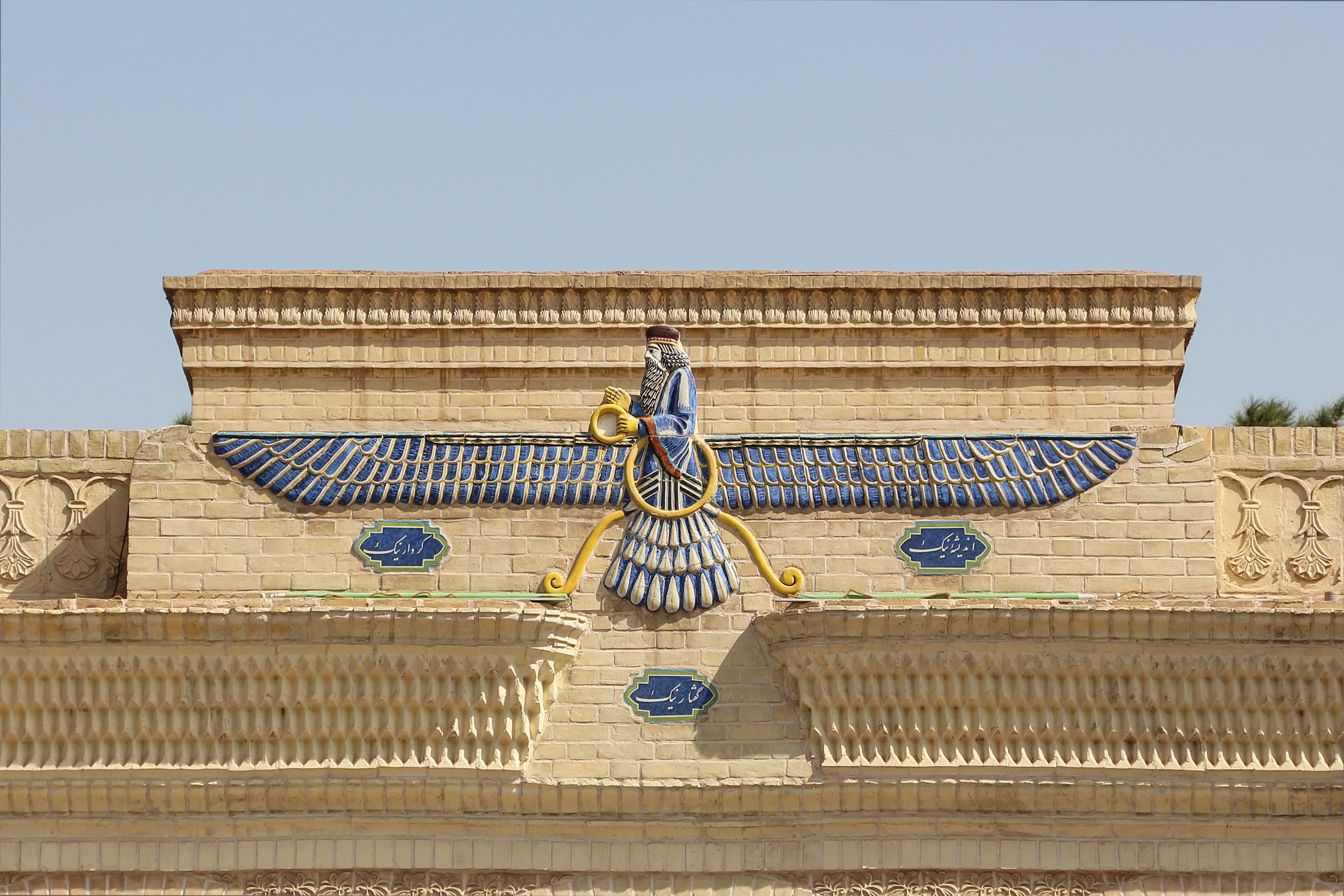
We dedicate this to the people of Iran who are fighting for their freedom.
We pray for your renaissance.
Drawing from Zoroastrian wisdom, we can construct a powerful framework for understanding the fundamental forces that shape existence and guide spiritual practice. By mapping two essential dualities onto perpendicular axes, we create Zarathustra’s Quadrants—a tool for discernment, self-examination, and conscious spiritual development.
Two Axes of Existence
Axis 1: Creative-Destructive Polarity
The first axis extends from Ahura Mazda to Angra Mainyu, representing the fundamental tension between constructive and destructive forces.
Ahura Mazda, the Wise Lord of Zoroastrian tradition, represents the constructive and generative principle—the force that builds, creates, orders, and brings forth life. This is the impulse toward formation, organization, and manifestation.
Angra Mainyu, the Destructive Spirit, stands at the opposite pole. This is the principle of dissolution, decay, and destruction—the force that breaks down structures, dissipates order, and returns things to formlessness.
In Zoroastrianism, it is important to understand that asha and druj are the spiritual emanations of Ahura Mazda and Angra Mainyu, respectively. Asha represents truth, righteousness, and cosmic order. Druj represents chaos, deception, and disorder. Asha is associated with light, and druj is associated with darkness.
Zoroastrians venerate Ahura Mazda and eschew Angra Mainyu, but in our order, we understand that we must seek wisdom in the Shadow.
Axis 2: Temporal-Eternal Polarity
The second axis runs from Zurvan to Ameretat, capturing the distinction between temporal flow and eternal changelessness.
Zurvan represents time itself—the realm of becoming, change, and transformation. Here we find the flowing river of temporal existence, where all things are subject to process, development, and alteration.
Ameretat, meaning “immortality” or “deathlessness,” represents the eternal and changeless. This is the realm of the imperishable, the immutable truths that transcend temporal flow, the eternal principles that remain constant while the world of Zurvan churns and transforms.
Interestingly, there were once Zoroastrian sects called Zurvanites who believed that the god Zurvan was higher even than Ahura Mazda and Angra Mainyu, one suspects because there seems to be an ultimate power in the passage of time and the cycle of endings. What then should we do with neo-Platonist notions of the timeless or eternal, such as those we explore through kabbalah? Zurvan is powerful to a point.
The Four Quadrants
When these two axes intersect, they create four distinct quadrants, each representing a fundamental mode of being:
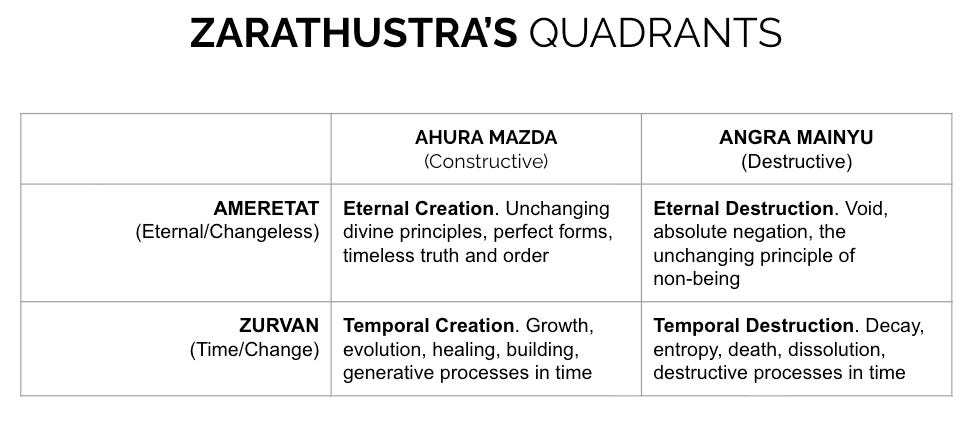
1. Eternal Creation (Ameretat + Ahura Mazda)
This quadrant contains the unchanging divine principles, the eternal forms of truth and order. Here resides Asha in its purest expression—the timeless law that governs reality, the perfect patterns that exist beyond the reach of temporal change.
2. Temporal Creation (Zurvan + Ahura Mazda)
Here, we observe all generative processes unfolding over time: growth, evolution, healing, learning, and building. This is the realm of spring planting and autumn harvest, of children growing to adulthood, of civilizations rising and flourishing.
3. Temporal Destruction (Zurvan + Angra Mainyu)
This quadrant encompasses decay, entropy, death, and all destructive processes that occur within time. The falling of leaves, the aging of the body, the erosion of mountains—all natural dissolution belongs here.
4. Eternal Destruction (Ameretat + Angra Mainyu)
This is the most challenging quadrant to contemplate, because its worship is nihilism. It represents the void, absolute negation, the unchanging principle of non-being—such as Ein—that precedes even Ein Soph. This is the abyss that stands opposed to eternal creation, the fundamental “no” against existence itself.
The Four Practices
Practice 1: Eternal Creation (Ameretat + Ahura Mazda)
This is the path of alignment with timeless truth—the highest aspiration of spiritual practice.
Meditate on the eternal principles of Asha (truth and cosmic order)
Act so as to build lasting goodness beyond your lifetime
Connect to divine, unchanging wisdom
Study sacred texts and eternal teachings
Contemplate the forms and patterns that transcend time
This practice calls us to lift our consciousness above the flux of temporal existence and align ourselves with what is eternally true and good. When we act from this quadrant, we plant seeds that can bear fruit for generations, we speak truths that remain valid across centuries, and we create beauty that reflects the eternal.
Practice 2: Temporal Creation (Zurvan + Ahura Mazda)
This is the path of engaged service in the world—the work of building and healing within time.
Heal, teach, and serve in the material realm
Grow plants and steward the delicate ecologies
Work creatively, letting divinity flow through right process
Raise children and nurture your community
Build institutions and infrastructure for a consent-based social order
This quadrant honors the sacred work of manifesting goodness in the world of change. Here, we acknowledge that while eternal principles guide us, the actual work of creation unfolds in time through patience, effort, and gradual transformation. The farmer who tends crops, the teacher who guides students, the builder who constructs shelter or temples—all work in this quadrant.
Practice 3: Temporal Destruction (Zurvan + Angra Mainyu)
This is the path of recognizing necessary endings—the wisdom of knowing when to let go.
Discern:
What must decay to make room for new growth
The difference between natural entropy and malicious harm
When to release what no longer serves
The role of death in the cycle of life
How destruction in time can serve ultimate creation
Not all destruction is evil. The forest fire clears deadwood for new growth. The composted plant feeds next year’s garden. The demolished building makes space for new construction. This path requires the difficult wisdom of accepting impermanence and working skillfully with the destructive forces that operate within time.
Practice 4: Eternal Destruction (Ameretat + Angra Mainyu)
This is the path of confronting absolute negation—the most perilous yet potentially transformative quadrant.
Confront the void, the abyss, and existential doubts
See what must be utterly rejected (druj in its purest form, the negation of truth)
Avoid the temptation to nihilism
Mark the boundary between being and non-being
Reckon with the ultimate “no” that defines the ultimate “yes” in the Unity of Opposites.
This quadrant represents the darkest territory of spiritual exploration. Yet encountering it is necessary. To know what we utterly reject helps clarify what we absolutely affirm. To peer into the void can strengthen our commitment to truth. Facing eternal negation deepens our appreciation of eternal creation. This path is dangerous and should be approached with caution and spiritual preparation, like Milarepa, who confronted demons in the cave.
Daily Practice: Living with the Matrix
Morning Contemplation
Begin each day by asking,
Where am I today in the Matrix? What quadrant calls to me?
Consider what work lies before you and which energies you must engage. Perhaps today requires the patience of Temporal Creation, or the wisdom to accept Temporal Destruction. Or, perhaps you need to reconnect with Eternal Creation through meditation and study.
Evening Examination
At day’s end, review your thoughts, words, and deeds—the three pillars of Zoroastrian practice. Reflect by asking,
Which quadrant governed my actions? Did I choose wisely?
Did you build when you should have built? Did you let go when necessary? Did you maintain a connection to eternal truth while working in time? Were you pulled unconsciously toward the void, or did you consciously choose your path?
Life Work
The ultimate spiritual aspiration is to move consciously toward the upper-left quadrant—Eternal Creation—aligning yourself ever more fully with Ahura Mazda and Ameretat. Yet wisdom requires honoring the necessary work of the other quadrants when circumstances demand it. This is Zarathustra’s paradox.
A spiritually mature person recognizes when to create and when to allow destruction, when to grasp eternal principles, and when to work patiently within time. She navigates the Matrix with discernment, choosing consciously rather than being pulled unconsciously by forces she doesn’t understand.
Reflection
Zarathustra’s Quandrants offer more than an intellectual framework—it provides a compass for spiritual navigation. By mapping our experiences, impulses, and choices onto these two axes, we gain clarity about the forces operating in our lives and the choices available to us.
The ancient wisdom of Zoroastrianism, perhaps the world’s oldest monotheistic tradition, recognized these fundamental dualities. By bringing them together in this matrix, we create a practical instrument for the eternal work that Zarathustra proclaimed: to choose good thoughts, good words, and good deeds, and thereby align ourselves with the forces of light, truth, and creation.
In every moment, we stand at the intersection of these axes. May they guide us in spiritual freedom and responsibility.
It never ceases to amaze me how much of this wisdom has been with humanity for over 2,500 years... but despite that the world is still in the topsy-turvy state it's in...